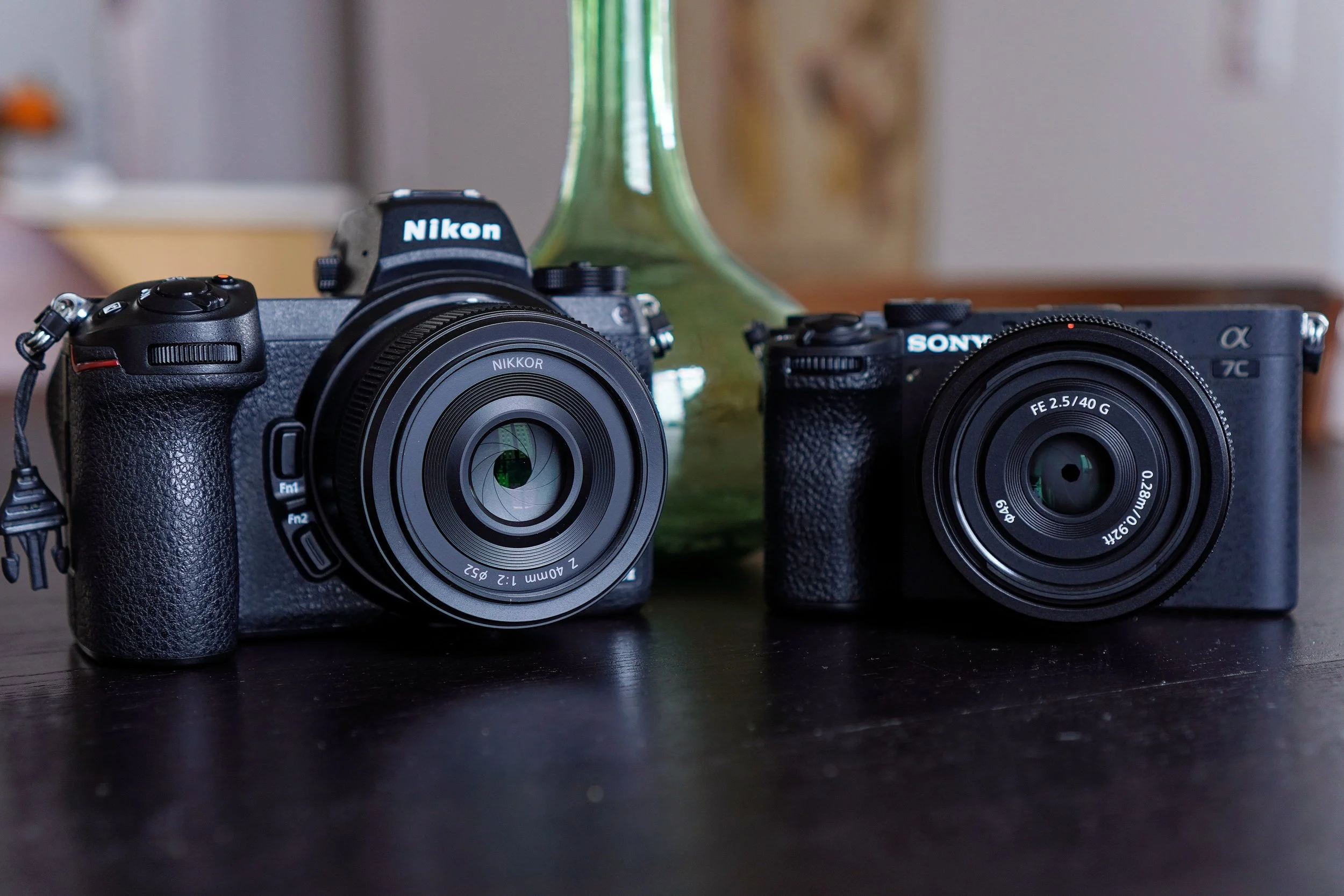
In 2021, a vey small club got two new small members. Let’s call it the Fast Forty Club. The Nikkor Z 40mm f/2, at 170 g, was and remains the only lightweight normal-ish prime that Nikon has on offer for its mirrorless mount. Though its MSRP of $300 is already low by current standards, you can now get it new for around 200 USD/EUR, which could easily be less than the sales tax on your fancy new camera.
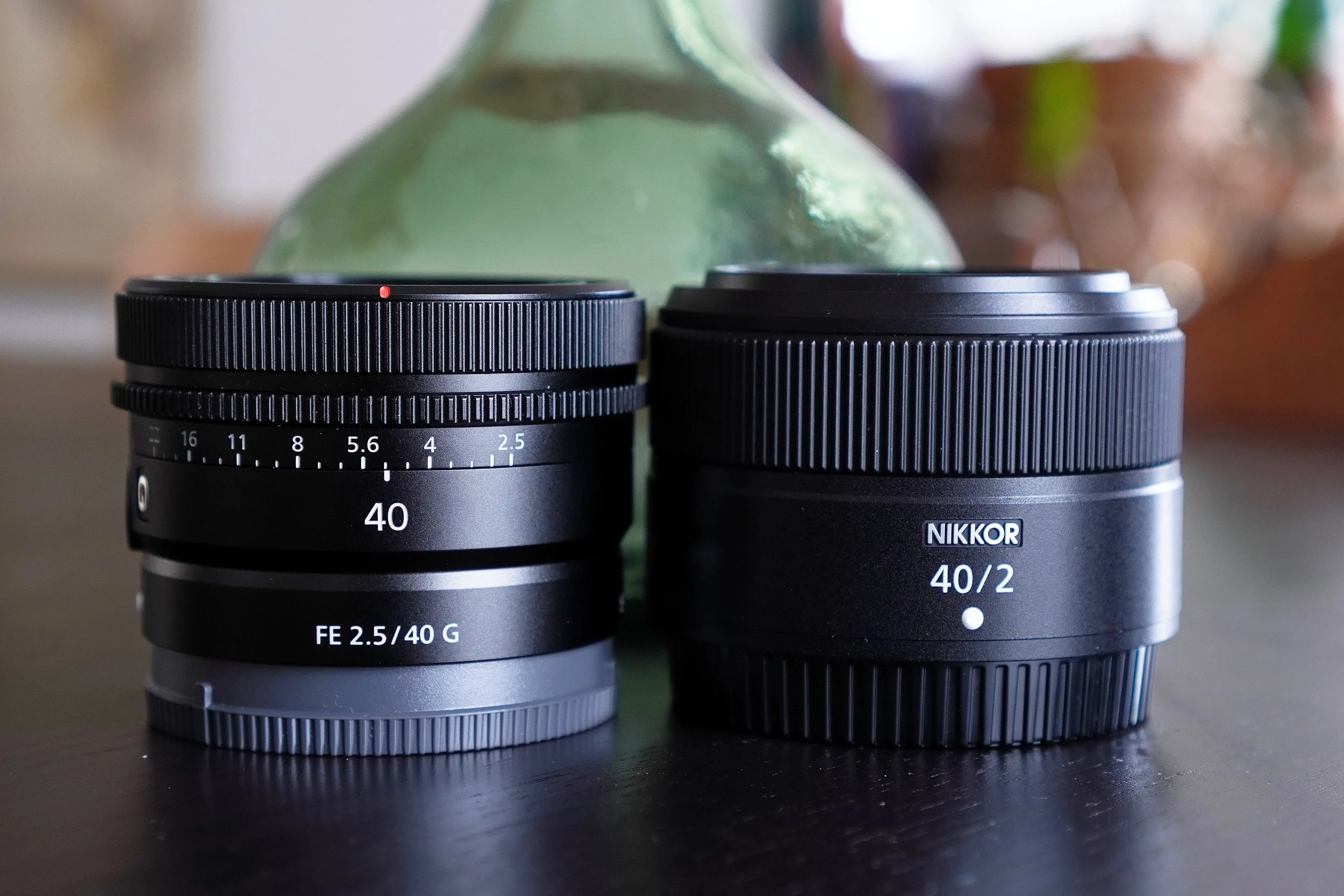
The Sony 40mm f/2.5 and the Nikon 40mm f/2 are almost exactly the same size and weight. The Nikkor is a 2/3 of a stop faster and over a full stop cheaper.
Sony’s FE 40mm f/2.5 G was announced alongside the similarly-sized 50mm f/2.5 G, so in one swoop Sony added two compact normalish lenses to its lineup. Until that point, the only other similarly-lightweight native option was the aging 50mm f/1.8, a value play that makes a number of sacrifices to hit its low price. The “G” in this lens’s name is Sony’s way of suggesting that it cuts fewer corners. Despite the modest maximal aperture and 172 g weight, this is a premium lens: twin linear AF motors, metal (probably aluminum) body construction, aperture ring, function button, focus mode switch, and (one hopes) strong optical performance. Sony can tick these boxes because the MSRP is a rather rich $800, and as I write this it’s on “sale” at B&H for $750. I got a better deal on mine in France with a Black Friday combo deal on a Sony A7C II, where it contributed maybe 500 EUR to the price. Still not cheap for a lens with modest optical specs.
Cheap Apples vs Expensive Apples
I’m going to get into my usual digressions later, but I’ll cut to the chase up front for a change and just tell you: Nikon’s 40mm might not be quite as “good” as Sony’s, but it’s still very good. Some could argue pitting lenses with a 3 to 4x price delta against each other is comparing apples and oranges, but impressively, these are both apples. You could bake either one into a pie and it would be tasty.
I shot the Nikon on a Z6 II and the Sony on my new A7C II and put the raw files through DxO PhotoLab, “adjusted to taste” as they say on DPreview. PhotoLab obviously has profiles on both lenses and no doubt corrects basic distortion and whatever aberrations it can clean up, and the bodies themselves might also be pre-cooking the raws. Then I realized my apple pies actually weren’t really comparable because I’d baked them in different ovens: the 24 megapixel wood-fired stove of the Nikon vs the 33 megapixel convection oven of the Sony. You can’t just down-res the larger file, that would be like microwaving the pie after you cooked it… OK, I’ll drop the metaphor. This isn’t a serious test, anyway.
How not serious? Well, for my near-infinity sharpness test, I didn’t realize the Z6 II had missed focus until after I returned the lens. Check this out:
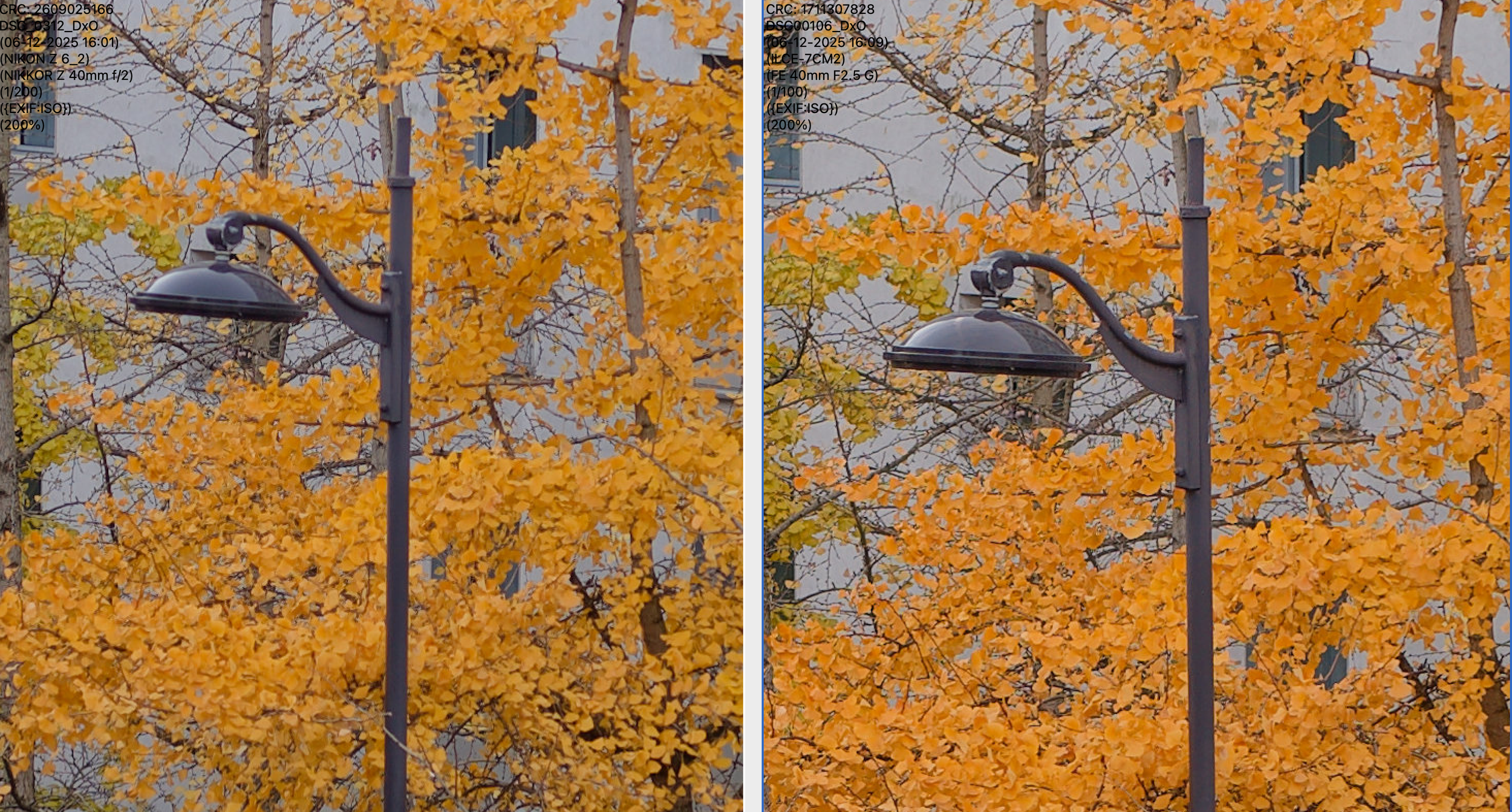
Nikon (left) vs Sony, center crop at 200%. Even at this stupid magnification, you might not see much difference at first glance. If you click through to the full size image, you’ll see the Nikon missed focus on the lamp.
Maybe I’ll allow a brief digression here to say that if you feel spiritually drawn to Nikon because it’s a camera maker that by-and-large seems to understand how photographers want to interact with their machines, but you’re just not sure about the AF performance of the company’s early Z-mount cameras… you’re right to be concerned. I bought the Z6 II to investigate this question, and found that while its AF is serviceable, it’s a full step behind the best from Sony. It’s not broken, it’s not terrible, it’s a thousand times better than what I accepted as pretty good twenty years ago, but if you want tracking AF that just mindlessly works almost all the time (which is what Sony has offered for a several years now) this isn’t it. By all accounts the latest generation of Nikon bodies (Z8, Z9, Z6 III, Z5 II) largely redresses this imbalance, but you’ll have to wait for them to lose a lot of resale value before you’ll hear about it from me.
Anyway, apart from tracking AF choke-ups, the Z6 II can apparently still just miss focus on static targets. The sample above was shot was in AF-S mode, with the square smack on that street light. The Sony hit it, which is nothing to brag about. The Z6 II missed both shots I took, focusing on the deeper background, and worse, to differing degrees, though the mistakes weren’t obvious in the moment.
But looking at that background, we see that central sharpness is good, so I can say that at longer distances, both lenses do a good job of resolving what they’re focused on, and that remains largely true right into the corners, even wide open. If common sense and people with real testing equipment are to be believed, MTF figures for both lenses are not actually the same across the whole frame. But I would be hard-pressed to see a difference with artistic/practical importance at realistic magnifications in either lens.
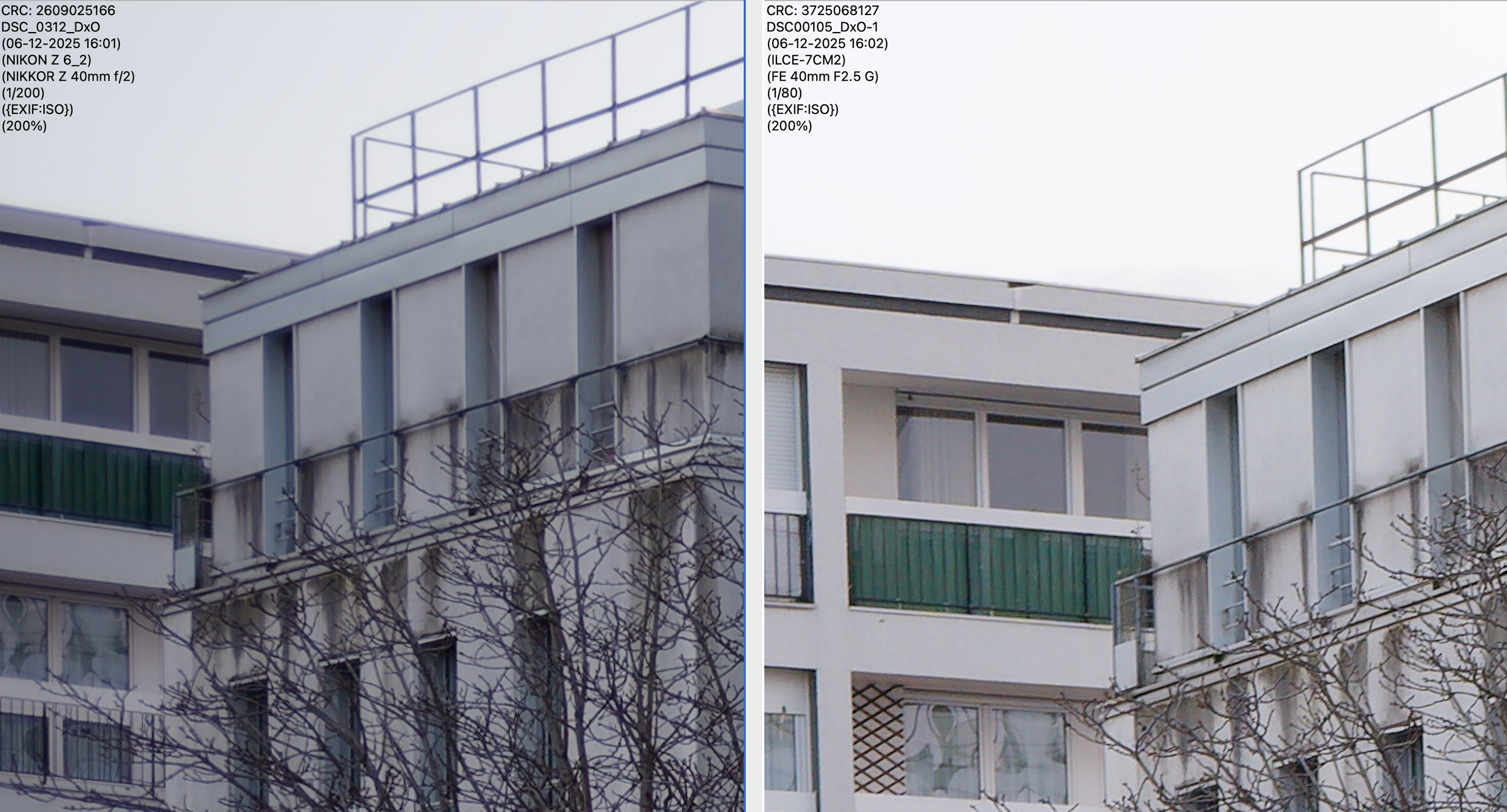
Nikon at f/2 (left) vs Sony at f/2.5, top left crop at 200%. The Sony is better, but at realistic magnifications, it’s not much better. Vignetting is also handicapping the Nikon. That clears up a lot at f/2.5. Unfortunately my f/2.5 test shot with the Nikon missed focus even worse than this one, so comparing corner sharpness is bust.
I keep vignetting compensation turned off in PhotoLab because I’m old-school like that, so I saw that the Nikkor shows really noticeable falloff at f/2. If that’s not your thing, the correction can be done automatically, but at the risk of a noise penalty. By f/2.5, the corners have brightened to more or less match the Sony. There’s also the possibility that the Sony is pre-brightening the raw file (the Nikon body might as well, concealing even graver sins in the lens design — such is the modern world that one is never quite sure about these things).
In the damp, cold two weeks I had the Nikkor I wasn’t doing any landscape photography so unfortunately that test shot out my window is all I’ve got to show you for longer distance. Closer up the lens continues to hold its own against the Sony. Behold:

Nikon at f/2 (left) vs Sony at f/2.5, halfway off center crop at 200%. No obvious difference here.
Use your imagination to compensate for the minor increase in linear resolution that the Sony’s denser sensor captures along with an fudge factor due to the fact that I wasn’t using a tripod to lock in the shooting position and I think you’ll agree that wide-open, both lenses do a good job resolving detail just a bit off-center here. I don’t worry about corner sharpness at portrait distances and closer because I’m not doing any repro work or archival wall documenting.
I also tried the Nikon at f/2.5, and lo, it looks softer than wide-open because the camera misfocused. I’m not sure what the camera was going for but the plane of focus seems just slightly in front of everything in the scene. The books in the crop only look out of focus when compared to the perfectly sharp results from the Sony, but seeing the large amount of blur on items deeper on the shelves in the Nikon image makes it clear what happened.
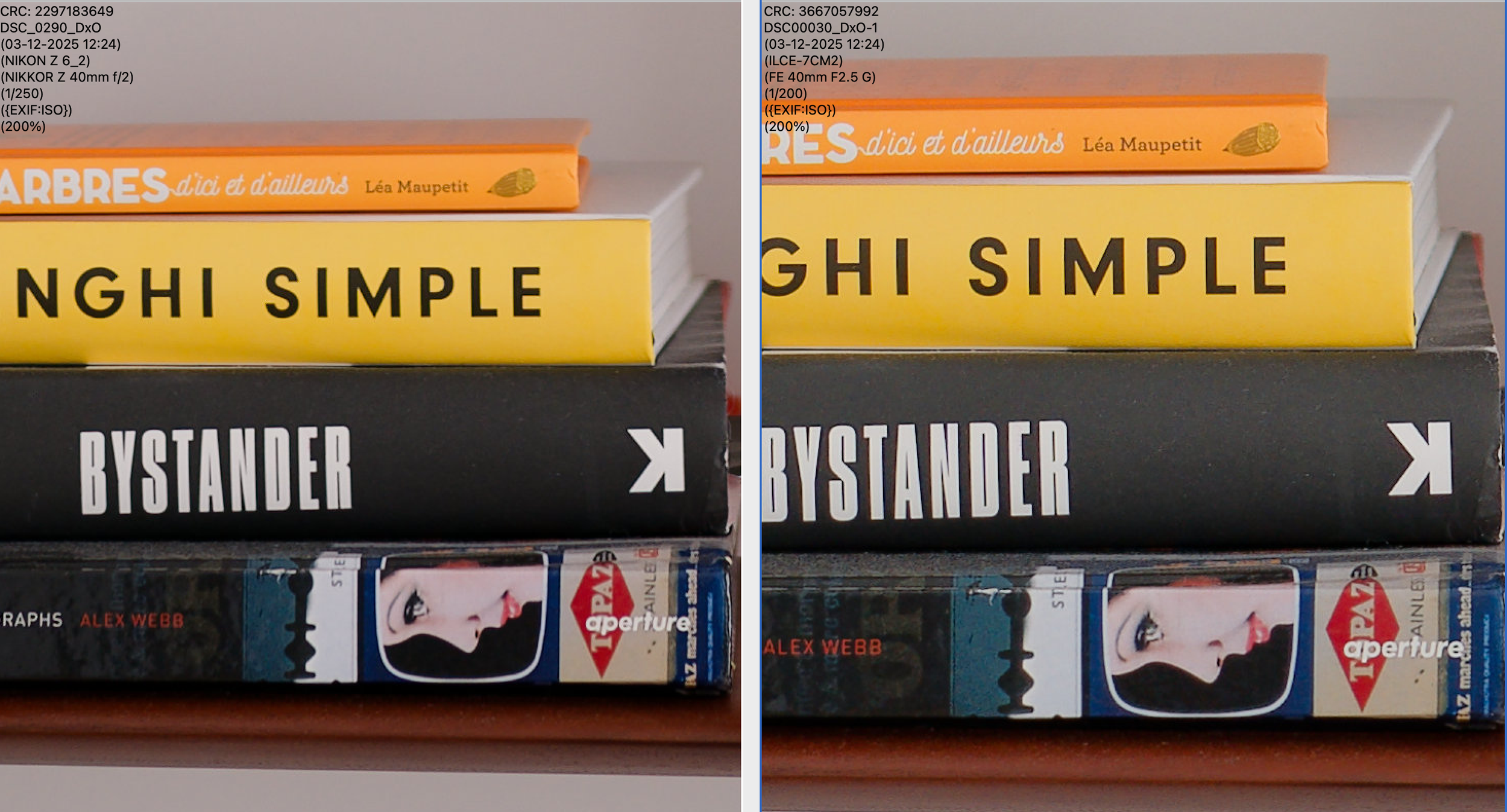
Nikon at f/2.5 (left) vs Sony at f/2.5, halfway off center crop at 200%. The Nikon front-focused by enough to be a problem.
Modern tastes preclude shooting at anything but wide-open so that’s all the stopping down we’ll do for now. In that vein, what about bokeh? Sony’s marketing explicitly points up out-of-focus rendering as a strength of its 40mm. Of course, what that means if hard to define.

Nikon on the left, Sony on the right, fit to screen.
The disco-inspired still life above gives some ideas about how the lenses handle out-of-focus backgrounds. I’d rate the overall rendering as fairly smooth, though this isn’t a torture test. The monstera on the left doesn’t look too busy. The Nikon manages a bit “more” blur since its light hole is that much bigger.
Let’s look at the background highlights:
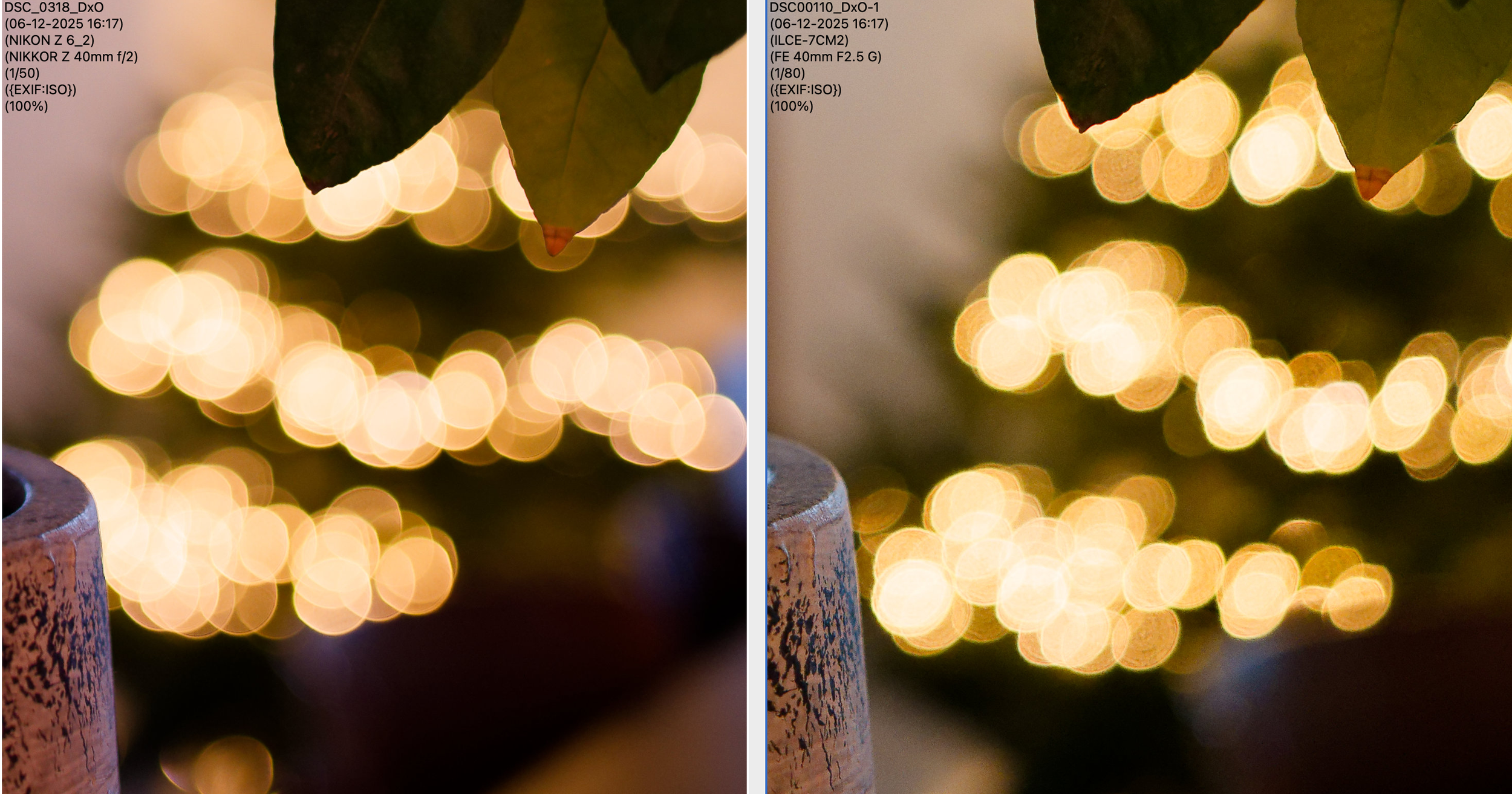
Nikon on left, Sony on right. The Sony gets catty with off-axis light sources.
The Christmas lights in the background show green outlines with both lenses, a symptom of uncorrected longitudinal chromatic aberration. Doesn’t much bother me. The Sony shows much more optical vignetting (the cats-eye shape of the bokeh balls, which becomes more pronounced towards the edge of the frame as the lens barrel shades out incoming light). Both lenses, unsurprisingly, resort to the dark arts of aspherical elements to achieve modern performance levels: the Nikon has two, the Sony three. Maybe that 50% increase explains why the Sony shows a lot more onion-ring patterning in its bokeh balls, or maybe Nikon just has more old-school optical fairy dust to spread around, I don’t know. Overall I prefer the Nikon’s OOF rendering here, but only as a connoisseur: in practice, I can’t see it making much difference.
Conclusion
Bottom line: these are both good lenses. The Nikon is more significant in the context of Nikon’s Z system as the only lightweight, fast prime in its range, which damns the depth of the Z lineup and/or illustrates the general trend towards spec-monster primes that privilege speed and performance over practicality and cost. Even the modestly fast Nikkor Z 50mm 1.8 is pretty chonky, albeit reputedly excellent wide-open. If I were seriously looking at the Z system, this 40mm could make the difference between buying in or not. It helps offset the lack of a truly compact, lightweight Z-mount photo-centric camera.
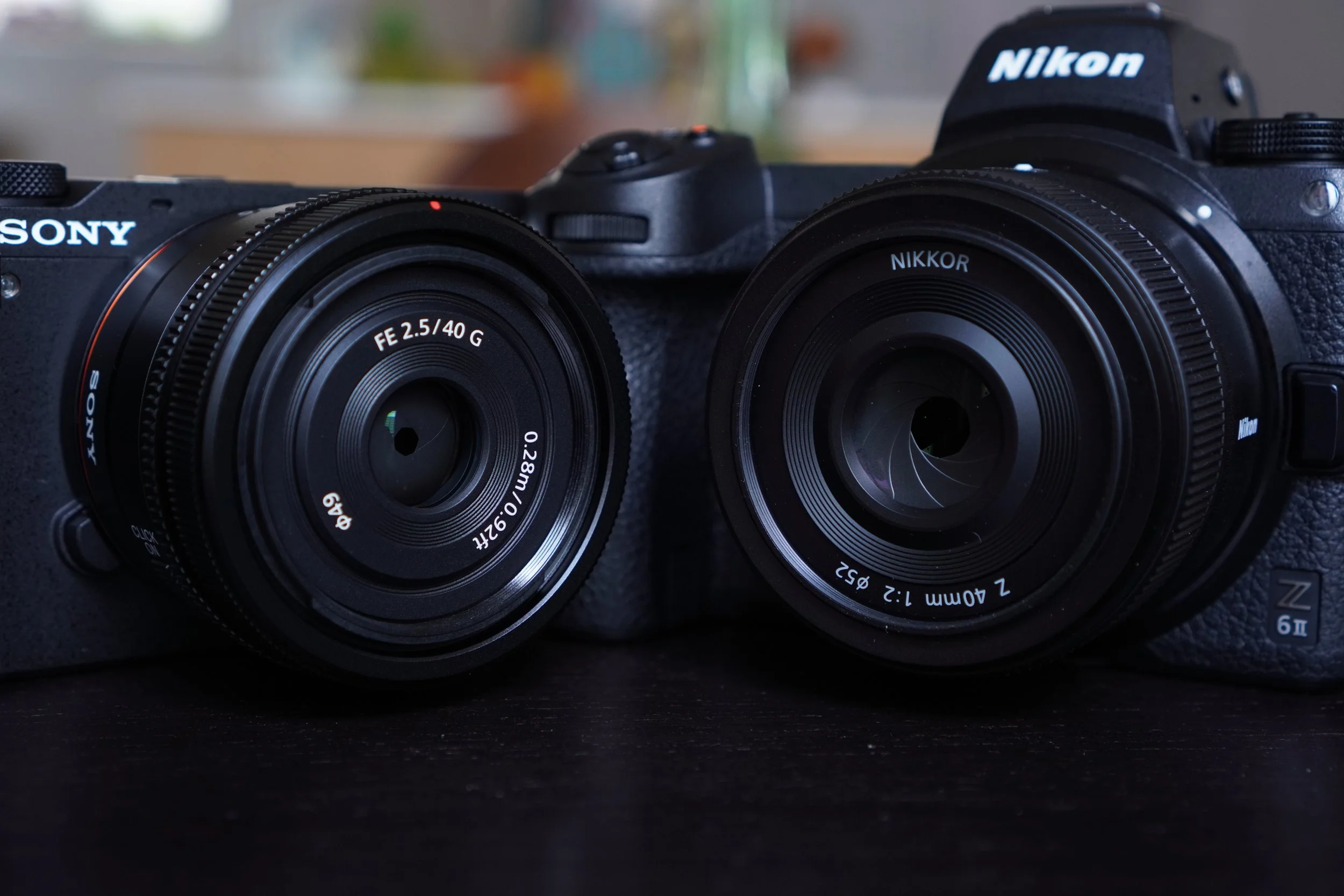
Two households, both alike in dignity
The Sony is probably a hair “better” by the numbers and is more satisfying as a well-built object, but costs way more and is far less critical to the health of the E-mount lens ecosystem, which is an embarrassment of riches. Paired with the impressively compact and lightweight A7c cameras, this lens (along with the 50mm 2.5) makes a good argument against APS-C bodies for people who prioritize this field of view. You pay essentially nothing for the larger sensor except for, well, quite a lot of money. Size and weight-wise, there’s nothing to distinguish this setup from the APS-C A6700 with the Sony 35mm 1.8 OSS, a lens that’s also extremely long in the tooth, hailing from a time before linear focus motors and weather sealing were de rigeuer.
Tween or Taint?
With the rigorous testing out the way, let me philosophize a bit about the 40mm lens as a genre. I have long been a 50mm man, ever since a mix of zoom-ennui, artistic pretentions, physical laziness and rangefinderphilia drove me to primes over a decade ago. When men were men and zooms were for dilettantes, 35mm was wide, 50mm was normal, and 90 to 135mm was all the tele you needed. But of course there were other focal lengths to be had, and many systems featured a fastish forty.
Something about this focal length, when covering the 35mm frame, allows for extremely compact lens designs. I don’t understand optics well enough to know why, but just as animals keep evolving into crabs, 40mm lens design bends towards the pancake: consider the Pentax 40mm f/2.8 in K mount, the Canon EF 40mm 2.8, the Olympus 40mm f/2, the Konica 40mm 1.8 in AR, and the Leica 40mm Summicron in M mount. I suspect the same optical principle also underpins the tiny Panasonic 20mm f/2 for Micro Four Thirds, which of course has a 40mm-equivalent field of view. A number of fixed-lens rangefinders from the heyday of that camera class also sported 40-45mm lenses.
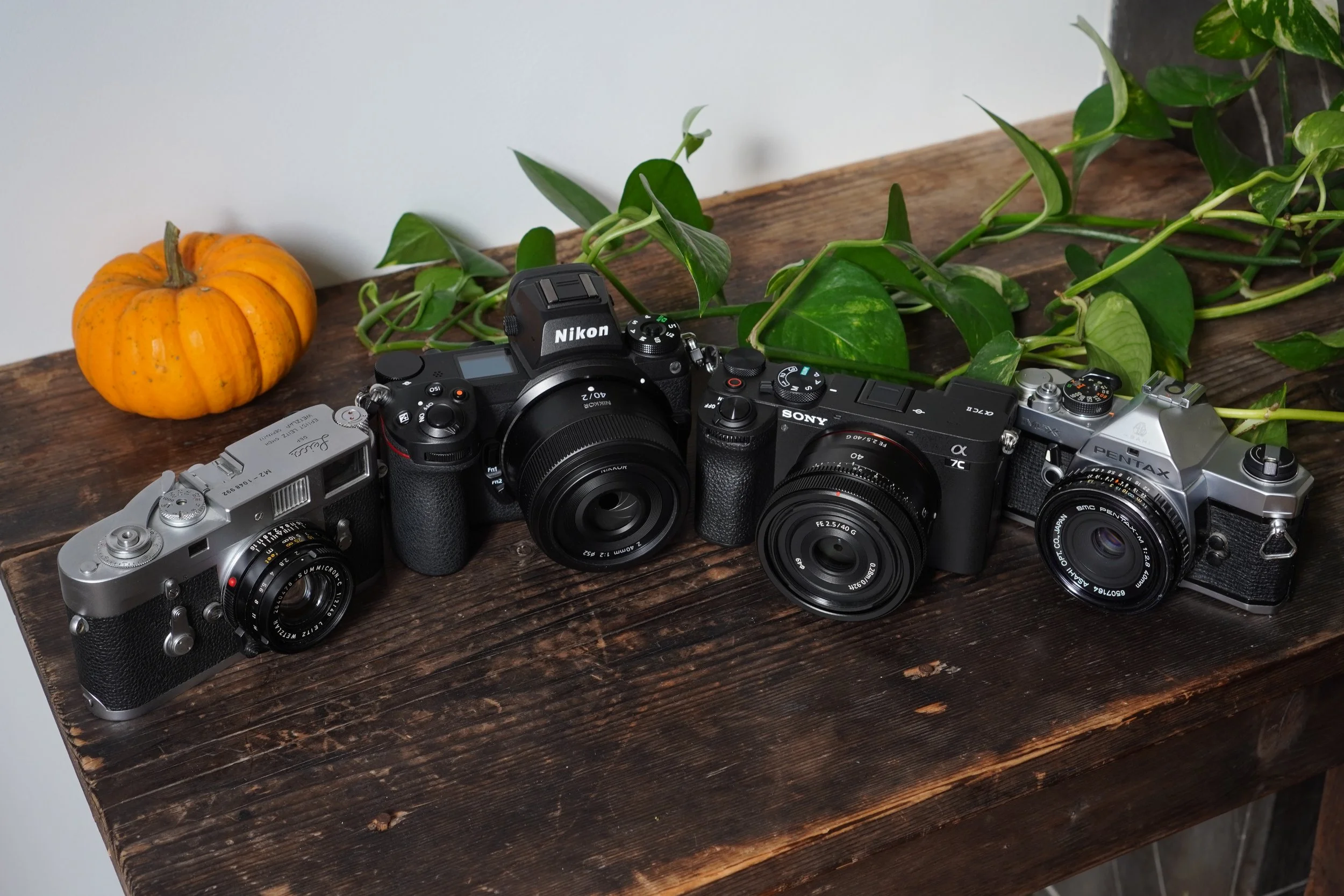
40mm across the ages.
With the exception of the Konica, which was the AR system’s standard lens, and the 40mm Summicron, which was made as the kit lens for the compact Leica CL, these were extremely optional lenses. The Olympus 40mm, apparently considered quite meh in its time, now sells for more than 10x the price of the contemporary standard Oly 50mm because of its rarity.
The Sony and Nikon lenses discussed here are of course not “pancakes,” a class of lens that has largely gone extinct, presumably under the modern pressure to deliver corner-to-corner sharpness on high-res sensors. But they are certainly far smaller than many high-performance contemporary 35 and 50mm primes, some of which could be mistaken at a glance for constant aperture zooms of yesteryear.
Plonked between the stalwart 35mm and 50mm focal lengths, the 40 is certainly a tween. But is it a ‘taint? My personal experience so far suggests it really does offer a useful middle ground, handling one- and two-person scenes better than the wider 35mm while feeling less constraining than the tighter 50mm for groups, interiors, and general-purpose photography. Modern sensors also mean that you can crop down to a 50mm equivalent FoV with quality to spare. I’m certainly not ready to give up on 50mm — if only because that would make my full-back tattoo of the 50mm Summicron rigid feel like a mistake — but there’s a versatility to the 40mm field of view that is worth exploring. I suspect many 50mm devotees who find 35 too wide for general use would also enjoy stepping out with a 40mm for a change.
.
.
.
.
Remember how, when music came on CDs, there was sometimes that hidden bit that started after an extended silence following the last song? A weird remix, jangling sounds, heavy breathing? Well, this is the blog post equivalent, in which I will consider the meaning of a “normal” focal length.
You will find two ideas of what a “normal” lens is on the internet. Most discussions posit that for the classic 35mm film format (digital “full-frame,” don’t get me started), a 50mm lens is considered normal because its field of view somehow approximates the normal way humans see the world. I probably read this a hundred times, and took thousands of photos with the 50mm field of view, before I noticed that the evidence of my own eyes flagrantly contradicts this supposition. A healthy human, even with our foward-focused predatory eye set-up, sees much more than the approximate 40 degree horizontal span of a 50mm lens (most “50mm” lenses are actually a bit longer than the nominal focal length, too). Don’t take my word for it: hold you finger out in front of your face and then swing your arm out while keeping your gaze fixed forward. When you arm is straight out to the side, wiggle your finger. You’ll see it moving over there, suggesting that your actual field of view covers close to 180 degrees. No, you can’t read a newspaper 90 degrees off axis, but you can see something. But our experiential field of view can also be much narrower than 40 degrees, such as when cannonballing down the autobahn at 100 miles per hour. This all points to the fact that eyes aren’t cameras: what we experience as “vision’ is really a patchwork of image flashes as our eyes saccade around the scene augmented with a healthy dose of imagination.
The other definition of “normal” one encounters is mathematical, stating that the normal focal length for a given format is equal to the diagonal of the frame. For classic 35mm, that’s about 43mm. That gives a FoV a good bit wider than a nifty fifty. I have seen various attempts to explain why this normal is good, but nothing convincing, though I agree that it provides a useful field of view as discussed above. I prefer this definition because it’s doesn’t read like a patently counter-factual AI hallucination.
Who cares? No one sane, probably, but I think it’s interesting that notions of normal are probably influenced as much by hundred-year-old lens design limitations (a fast, 50ish double gauss with strong performance was more practical to make than a 40ish lens with similar performance) as any spiritual connection to the way humans see the world. And now that you can have great performance at a reasonably price at virtually any focal length, maybe it’s time to reconsider, as we have in so many other spheres, what is normal anyway.
And now imagine the sound of the CD player’s laser transport whirring softly back to park by the spindle.