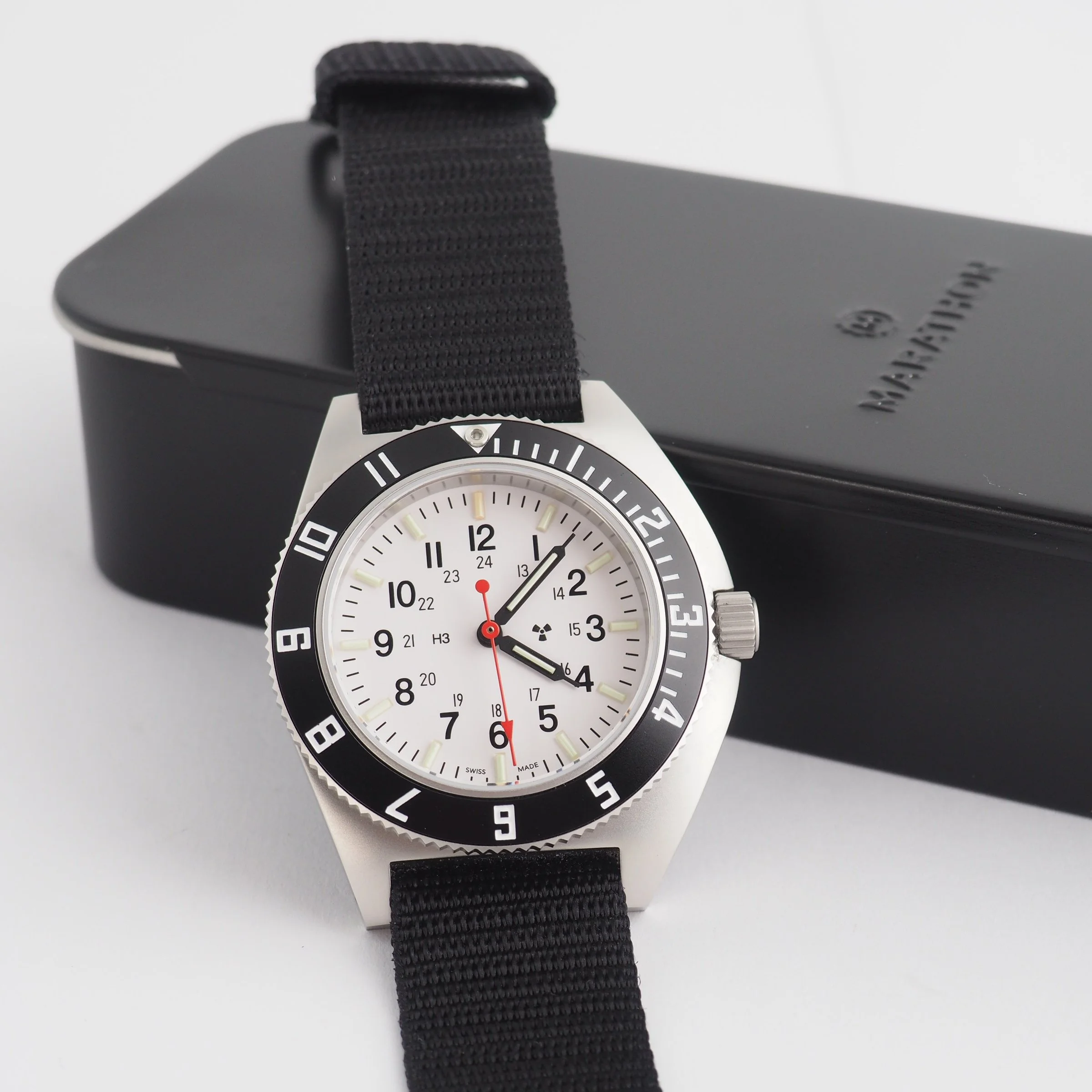
Today we consider the Marathon Arctic Steel Navigator (SSNAV), a military watch in white face with intriguing roots and an unusually accurate quartz movement. I bought one because shopping for a watch is cheaper than the therapy I would need if I had spent my free time thinking about other things, and also because my Tracer P59 came up a little short as a companion in the darkest hour of the soul, when I wake soaked in sweat and want to know the time. Four tritium indices were not enough. A disposable plastic movement was not enough. Quasi-military style by way of a Swiss office park was not enough. I needed more millicuries, more metal, more authenticity. In the SSNAV, I have found these things, and more. But does it satisfy the heart’s eternal hunger? Dear reader, keep scrolling to find out.
Best In the Long Run
Watch fancy is hugely about the stories and heritage of the companies that make these little machines, and this creates tremendous pressure to market those lineages. In some cases, this is bald-faced puffery: there are many storied watch brands that died in the quartz crisis, only to be resurrected in the next century by, say, a Hong Kong holding company that wastes no time setting up a website crowing “Since 1892.” Even many august brands like Longines that can draw a straight line back to their origins are now part of conglomerates like Swatch Group that arguably muddy the waters of their stories.
Marathon stands out for legitimately being a family business since its founding in 1939, with leadership passing from father to son for three generations. After a rocky start as just another watch assembler in Canada, the company hit on the idea to make watches for the military in 1941, which suddenly had a lot of wrists that needed the time on them. Later it won contracts with the US and other militaries as well. Reportedly as recently as 2020, 90% of Marathon’s business was still government contracts — not just military but various scientific and deep state actors who need to run to schedule.
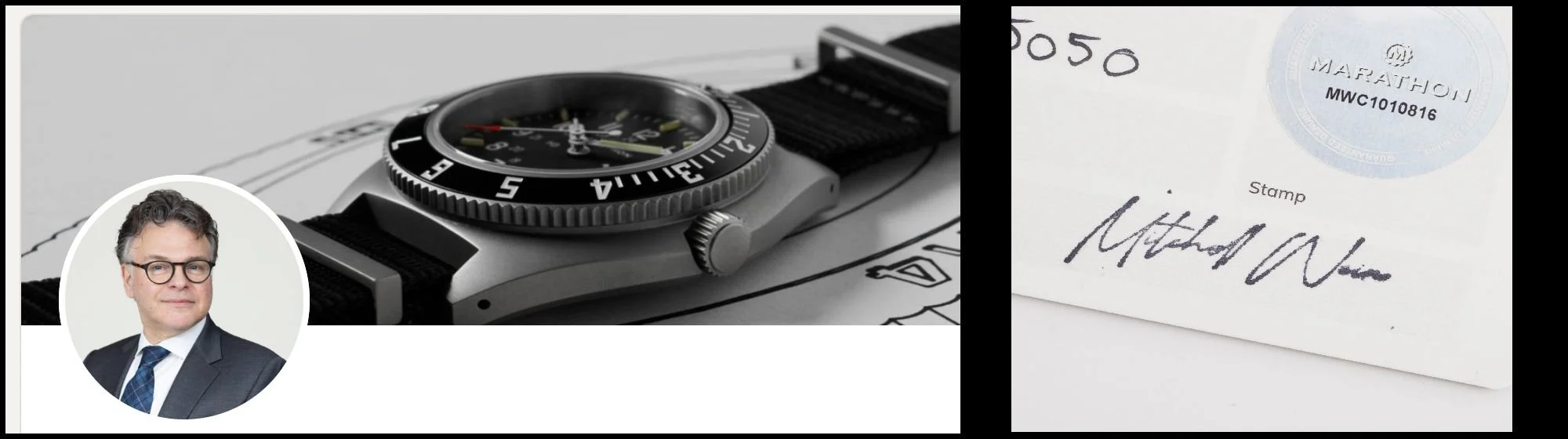
Mitchell Wein, President of Marathon, from his LinkedIn page (which features a Navigator!), and my warranty card.
The current President is Mitchell Wein, grandson of the founding father. His signature is on the warranty cards! Wein seems to be surprisingly accessible for the head of a real watch company. While the “CEO” of a microbrand with two employees will happily spray buzzwords at a fifth grader for a class project, most established companies are more selective, and their utterances have that airless, super-pasteurized flavor of unspeak typical of modern corporate communications. Wein on the other hand comes across as a guy who is kind of excited about watches and isn’t overly concerned about a misstep going viral on social media, which, to be fair, it probably wouldn’t. He’s not a gifted extemporaneous speaker, but that doesn’t stop him from going on a podcast to ramble about modern art, the role of the government, the fact of climate change. You really get a sense for his family’s deep contempt for “jewelry shops,” whose unpaid invoices originally pushed the company to seek out that more-reliable government cheese, paid upfront and without dither as long as the agreed brief was met. He also calls soldiers “warfighters,” which sounds authentic and inclusive.
Marathon definitely made its bones as a military supplier, but if you look at the company’s website in the Wayback Machine, you’ll find that it sold a bizarre mix of products, including kitchenware (“Muffin Pan, 6 Cup”), office supplies (“Desk Tray Supports, Beige”), and patio thermometers emblazoned with Canadian maple leaves. Next to the bundt cake molds there were also military watches, but not for normies (“This watch is available only to Government and approved Departments and Ministries”). The company has definitely slimmed down its portfolio, though you’ll find it still sells “tactical” laser pointers if you do a bit of digging on its site.
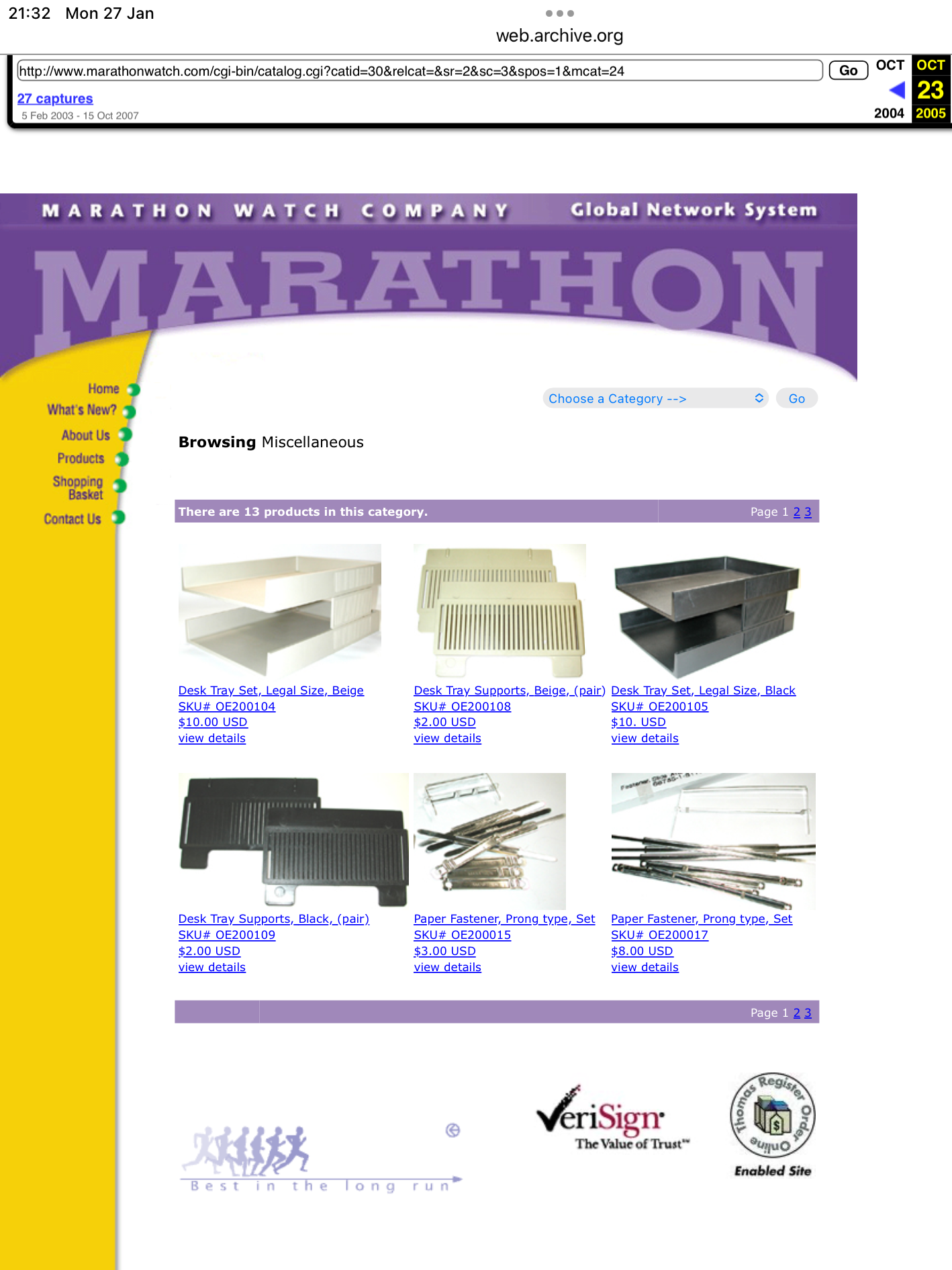
Back in the early 2000s, along with Watch, Wrist, Navigators, Marathon also sold Paper Fastener, Prong Type, Sets and Desk Tray, Supports, Beige. Supporting a war effort isn’t just glamorous man-jewellery.
Wein has spoken about the razor-thin margins the company has taken on its government watch contracts with obvious pride, but it’s easy to see the appeal of broadening the offering to dads like me, a market that typically supports 40 to 50 percent margins for the maker, if internet wisdom is to be believed.
Marathon’s production is now done at what looks like a large house in La Chaux-de-Fonds, in the Swiss watchmaking heartland of Neuchâtel. I’ve seen reports from folks who’ve toured the facility, and it seems like there are just a handful of people beavering away in there. As recently as 2024, when the SSNAV was introduced, the lead watchmaker was Jean Maurice Huguenin, who was actually involved in the design of the original steel Navigator watches (see more below) in the 1980s.
Normal watch aficionados who have no particular interest in military watches (a topic which is its own wormhole within the already cavernous rabbit hole of watch fancy) could pass lives without ever hearing about Marathon, a company that is invariably described in the watch press, when it comes up, as “flying under the radar.” I found it because I was specifically ferreting out watchmakers that use tritium, and that’s a small club.
Origins, Motives, Wars
I mentioned my Tracer up top. A capable watch in most respects, but with middle-of-the-night bleary eyes and brain, I found that just four illuminated indices was not quite enough for me to avoid occasionally misreading the time. Perhaps as importantly, the Tracer did not light up my heart. The design, the history, the movement: none of them set my imagination on fire.
Why not? Who can explain the heart, but we’re probably back to stories. The SSNAV has a good one. In 1986, the flyboys at the former Kelly Air Force Base decided they needed a watch that kept time reliably in their uniquely hostile work environment. According to one account I found:
“…[We] were issued the Hamilton GG-W-113 mechanical watch around 1985 or so. However, if we flew with these watches, we found that the watch movements would stop at times during our flights. We came to the conclusion that his was perhaps due to the G forces that we routinely pulled during our flights. Usually 6+ G's...good times!”
There was also the question of sudden drops in cabin pressure, which might be followed not by a dixie-cup oxygen mask deployment but the pilot being blasted out of the aircraft and into the near-vacuum of 40,000 feet by the explosive charge of their ejection seat. No sense ruining a good watch along with a multi-million dollar aircraft, am I right? So Marathon cooked up the original steel Watch, Wrist, Navigator, as the SSNAV was designated (and is still, on the caseback). Apparently the pilots approved. “[We] were issued these watches which worked perfectly fine! Kept mine until the mid 90s,” continued the reminiscence above.
()
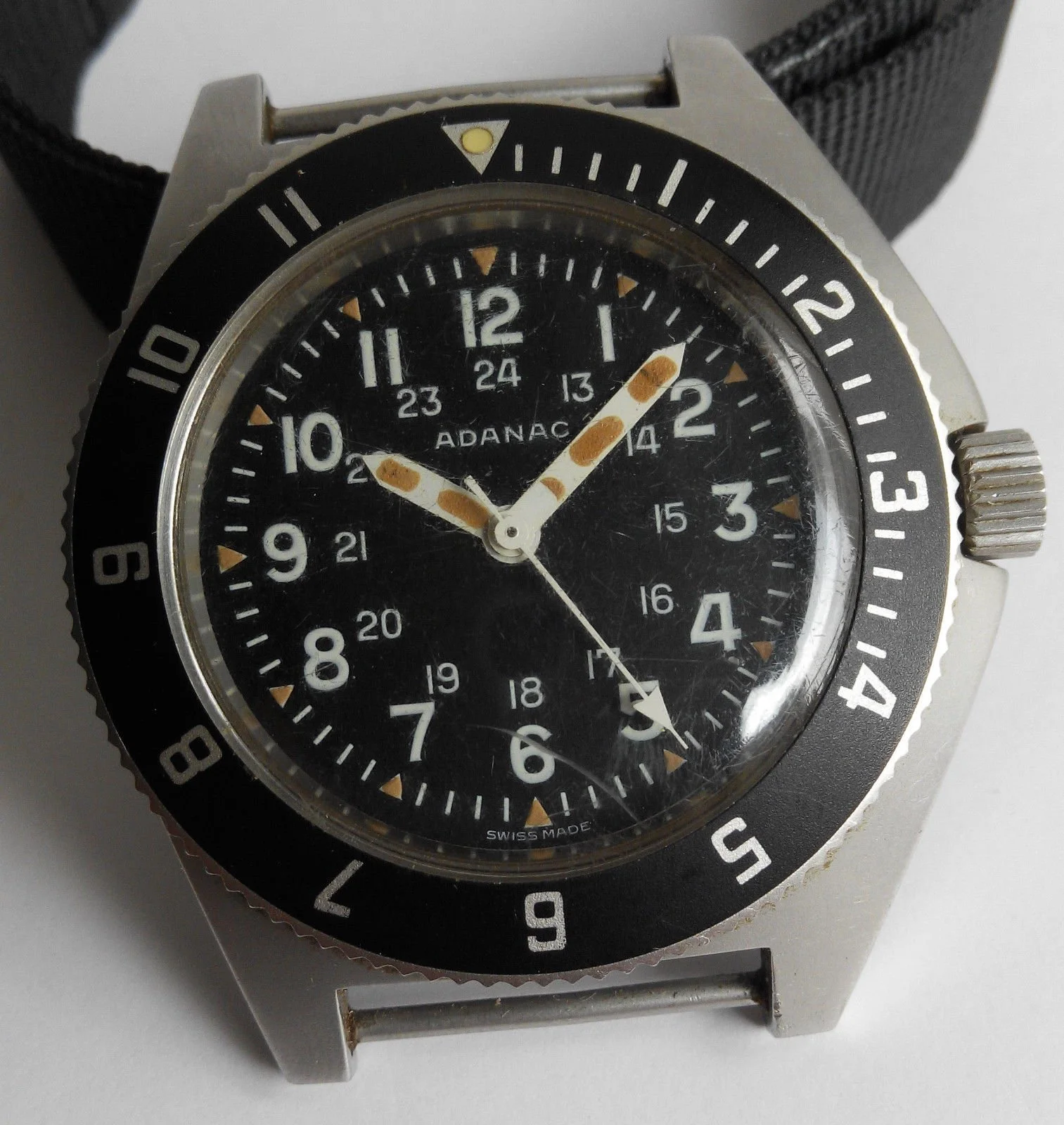
The original Marathon Navigator, with “ADANAC” on the dial since the contract prohibited branding and the Wein in charge was a proud CANADiAn. I can’t remember where I found this image. Note the fried tritium paint and the acrylic bubble crystal that distinguish it from the modern reinterpretation. Some of these early Navigators are marked “GALLET AND CO” on the back. I spent some time running down the link between Marathon and Gallet, a watch company with an amazingly long history that, when I started writing this review in 2024, seemed to be a shambling zombie indulging in some questionable business practices. Despite apparent efforts on Gallet’s part take credit for the Navigator’s development, I came away satisfied that Marathon just subcontracted production to Gallet to meet the volumes demanded at the time. Meanwhile, in 2025 Breitling acquired the Gallet name.
The Navigator was still flying when Saddam Hussein invaded Kuwait in 1990, a county he just happened to be crushingly indebted to after loans he took to fund his ruinous war with Iran. He figured he’d kill two birds with one stone: simplify his repayment plan, while also taking control of a significant proportion of the world’s oil supply. He knew the Americans were utterly averse to putting boots on the ground since having their asses handed to them by a bunch of pyjama-wearing commies just fifteen years earlier. He also apparently misunderstood some American diplomat-speak that he took as “Your business is your business” but really meant “Watch that thin ice.” So Saddam sent a whole lot of tanks across the desert for an armored smash-and-grab in Kuwait City.
It almost worked. Saddam was right about American reluctance, but eventually the US and its traditional allies along with, incredibly, a range of Arab states including Iran, put together an emphatic response (a young Saudi named Osama bin Laden, casting about for an enemy to replace the Soviets in Afghanistan, took malevolent note of this Western intrusion in Arab affairs). Was it because Margaret Thatcher told George Bush Sr. to man up? We all have to decide that for ourselves. The result was possibly the most lopsided conflict in modern military history. The Coalition of the Willing laid waste to the Iraqi forces, inflicting astounding casualties. US aircraft shredded retreating Iraqi armor on a road out of Kuwait that came to be known as the “Highway of Death.” The vehicles may have been mostly abandoned, but Iraqi casualties totalled up hideously regardless of where they happened. This is where Ken Jarecke’s famous photo of the charred Iraqi soldier was taken. And on the wrists of some of those American aviators as they shattered the Iraqi columns, a Marathon Watch, Wrist, Navigator.

American fighters over Kuwaiti oil wells destroyed by the retreating Iraqi army. Provided by the US Air Force. Public domain, via Wikimedia Commons
I was in high school and I still remember the queasy sense of excitement as the American public learned what all those fancy military toys could really do. See in the dark! Fly a missile through a window from a thousand miles away! At the time, it was fashionable to be against the war. After all, it was just about the oil, and it was a war, which was obviously bad. I hadn’t though much about it since then, having been more engaged with the follies of the forever wars that followed. But in researching this review I fell down a Dessert Storm jird hole and came away feeling rather differently than my teen-aged self, who was in any case breathtaking ignorant of nearly everything.
This is not the kind of thing that’s considered tasteful to look back on nostalgically, and any positive take on Gulf War I is often dismissed as chest-thumping nationalism to be underscored with a blare of hair rock. But in retrospect, it looks a lot like the last time a coalition of liberal democracies under a steady American hand got some serious shit done. Even fans of Saddam’s romantic historical fiction have to admit that he was a brutal, repressive and murderous despot, and his attack on Kuwait was an act of naked aggression no more justified than Russia’s invasion of Ukraine (though Kuwait is a less sympathetic underdog). The way things turned out also obscured the stones required by those living history forward: American military planners had warned the President to be prepared for allied casualties in the tens of thousands. And saying it was “just about oil” is like saying it was “just about power.” If you cede power to expansionist dictators, things usually don’t go well. No matter what, a lot of people will die. Will it be contractors on the Death Star or someone who stayed home to work the farm?
Case Report
So is that what the SSNAV stands for? Splitting the air in a fantastic machine, burning the innocent pawns of a wicked king alive? Perhaps. Let’s consider the case, the most striking aspect of the watch. It’s an asymmetrical design, with the whole right side extended to make a mondo crown guard. I’ve seen supposition that this is to prevent important tactical things like one’s parachute from getting snarled on the crown, though I don’t imagine paracord is fine enough to get hooked on a watch crown, but then again the only paracord I’ve ever handled was made into a camera strap, so what do I know.
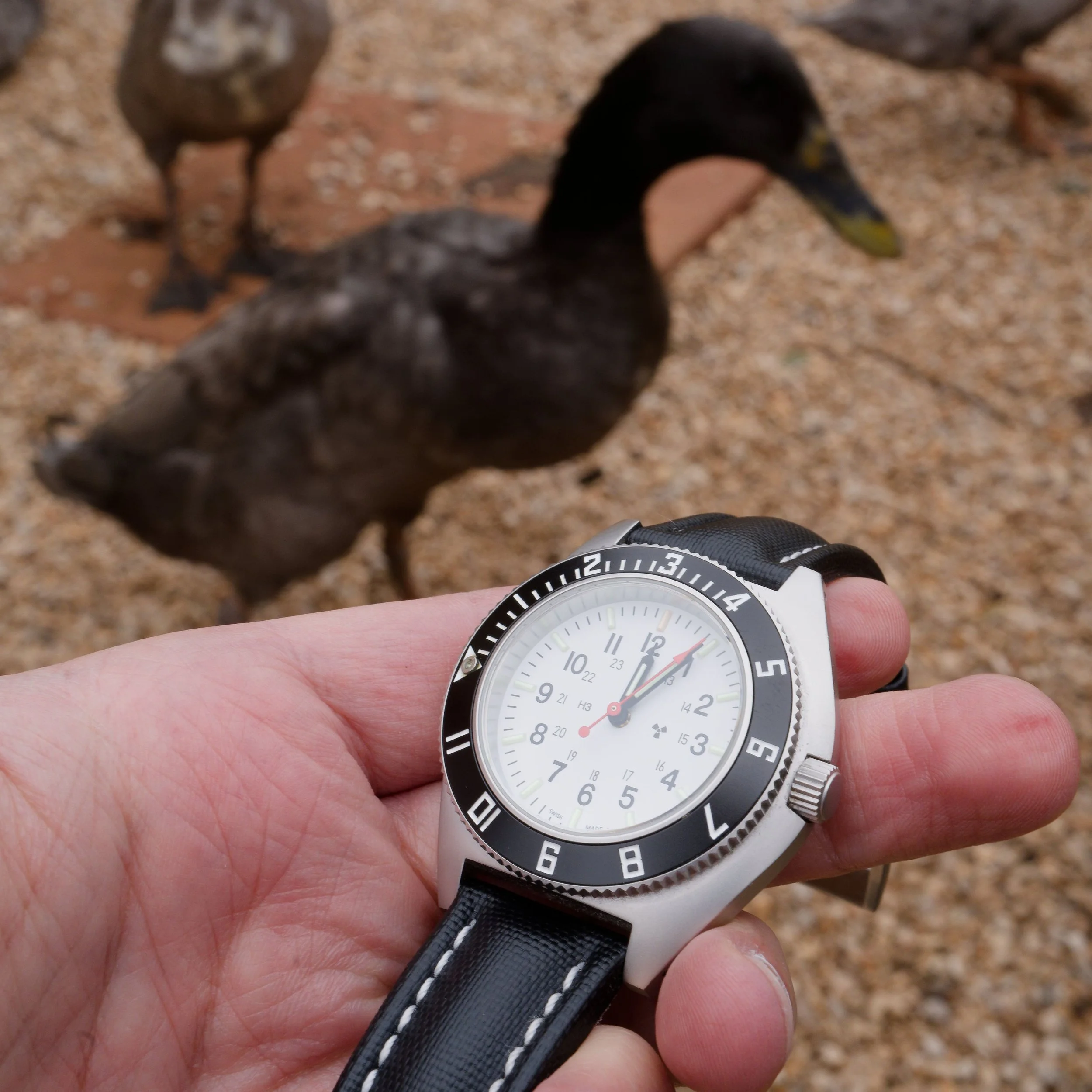
The SSNAV’s crown sunken into the protruding side. I think there’s only AR coating on the underside of the crystal, as it should be. Ducks are the A-10 Warthogs of the barnyard.
You can trace the idea of case-as-crown-guard back to Lemania watches made for the Swedish army in the mid 50s (the TG 195) — that’s the earliest I could find, though the execution is quite different from the SSNAV, with a less intense bulge. This pre-dates Rolex’s 1959 use of integrated case crown guards on the Submariner, the ancestor of most crown guards today,.
However, the obvious inspiration for the SSNAV case is a Benrus dive watch made for the US military through the 70s. I’m surprised these aren’t usually mentioned in reviews of the SSNAV; if it didn’t have its own cool origin story cf. Kelley AFB the SSNAV would have to be considered a Benrus homage. They look so similar that a Worn and Wound discussion of the Benrus watches appears to slip an original Navigator in as an illustration. To be fair the SSNAV isn’t trying to be a dive watch, which might throw off the comparison.
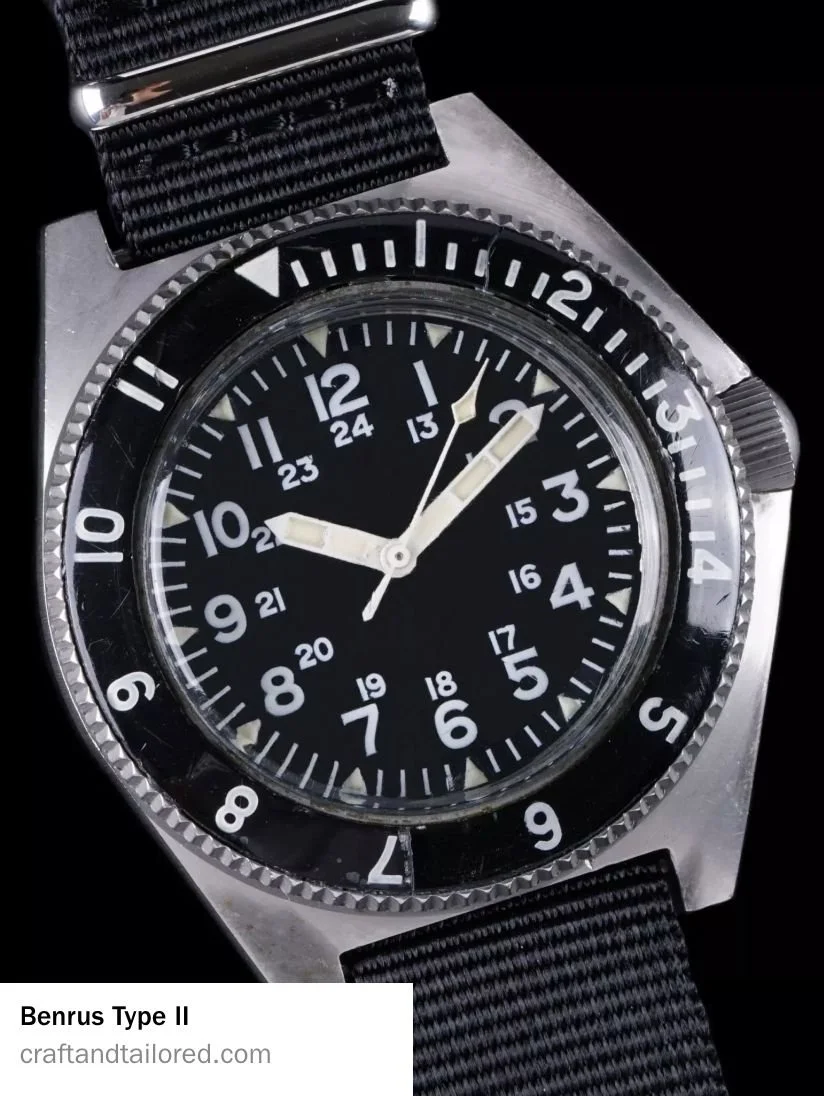
A Benrus and obvious influence on our hero. Playing devil’s advocate, I have to say that setting the crown almost flush with the casing is probably more protective than letting it poke out a bit like the Navigator does.
The case is 316L steel, generic for watches from $200 up. But the steel is also apparently “parkerized,” which I’ve never seen on watch before: it seems to be more common in firearms. It’s a coating treatment that enhances corrosion resistance. Pretty cool.
The asymmetry is not the case’s only quirk. Rather than a removable back to access the battery, the SSNAV has a small cover that you can open with a coin, like on an old camera. Marathon, putting mall battery replacement guys out of business. Inspection of the back at 9 o’clock reveals the pry point of a press-on case back: this is not the screw-down back you might expect on such a manly watch with a 10 bar pressure rating, despite what some reviewers say. Anyway, I think we can trust Marathon’s engineering here: after all, it’s the gasket that provides water protection, not the case threading.
The case is also effectively the interface between a watch and your wrist, so its architecture has to be compatible with yours. I’ve read criticism that the Benrus is uncomfortable, something about sharp lugs, but the SSNAV is an easy wear. It’s been on my wrist for about 23 hours a day for most of the last year and a half, and I have no complaints.
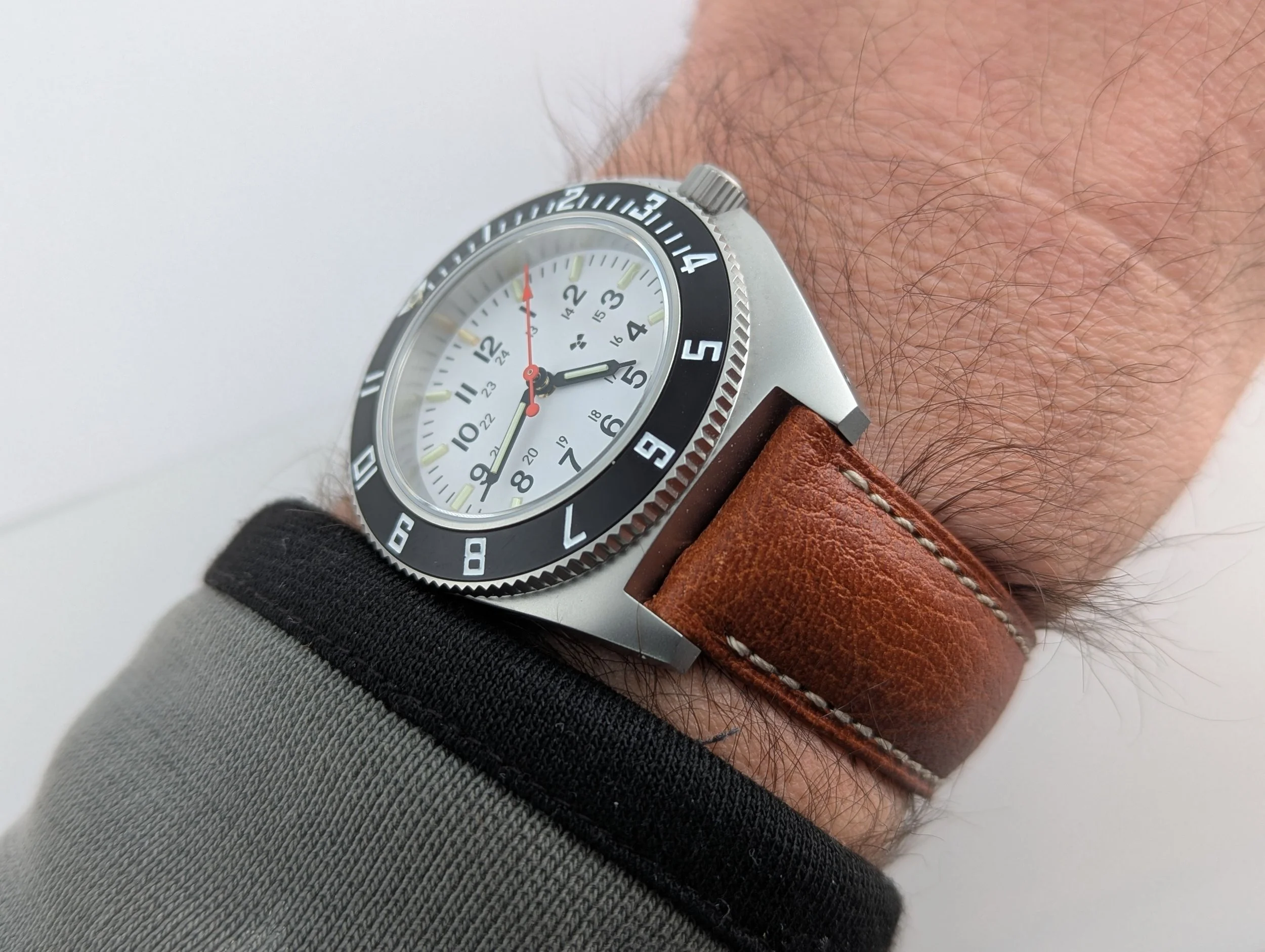
The SSNAV on a Hirsch leather strap looks a little more chill. Case finishing is clean and uniform with no flourishes. Here we can admire the bezel, with enough height to give your flight-gloved fingers a good grip. Lugs apparently drop more than on the original version; it’s very comfortable, and the steel feels solid without being overweight.
And there’s the rotating bezel. Despite the SSNAV’s resemblance to the Benrus dive watch, this is not a dive bezel: it’s bi-directional, and meant to track a second time zone, apparently useful when you’re flying a B52 a long way to make a delivery. Why then the minute markers between 12 and 4? Is there some flight-related task that might need timing but never takes longer than 20 minutes? Might as well ask, why 90 clicks on the bezel instead of 60 or 120. Ours is not to wonder why: our is but to do and fly. Or enjoy the utility of a GMT without the clutter of an extra hand on the dial. Anyway, I’m not a bezel aficionado but this one feels fine to me: clicks positively, no slop, doesn’t get knocked out of position much, and lines up properly at 12, at least on my example. The aluminum insert is the most cosmetically vulnerable part of the watch, but mine still looks new because I live soft.
Nuclear Option
I like watches I can read in total darkness (in bed, not on a night mission), and that keeps me coming back to tritium tubes. I did a deepish dive on this technology in my Tracer P59 review: skip down to the “Hellfire Hydrogen” subhead if your not interested in an affordable but otherwise undistinguished tritium watch. Basically, the tubes glow for a long time. My P59 only had tritium on the cardinal indices, so I eventually sold it, as I kept misreading the time at night. The SSNAV, at four or five times the price, doesn’t have to skimp on tubes: every index is marked, with orange for the 12 so you don’t get confused. Minute and hour hands are clearly differentiated. The automatic version of the watch also has a pip on the seconds hand, but not the quartz that I have, which I prefer since seconds are superfluous when I’m figuring out how badly I’m sleeping.
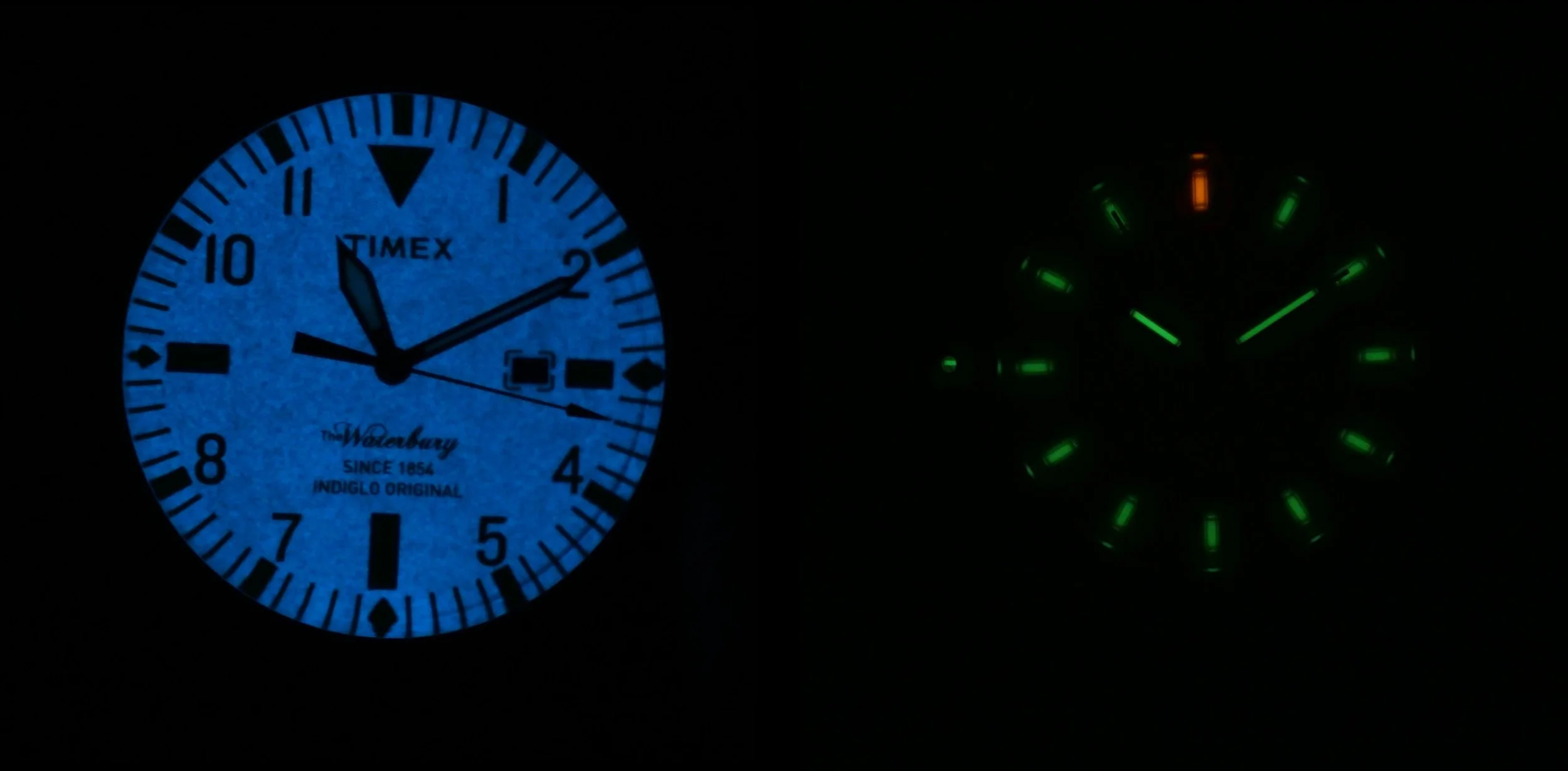
Lume shots for you, with a Timex Indiglo dial on the left for reference. Weirdly, the SSNAV’s dial is actually a lot easier to read in the middle of the night, maybe because its minimalism is more resistant to blur.
Here is a video I included in the P59 review showing cosmic rays, alien cousins to the beta particles flying out of the decaying tritium in these watches, crashing through gaseous alcohol. The squiggly, spindly tracks are left by beta particles.
Dialing In
In daylight the dial is also very legible. I like the “arctic” color scheme as a matter of personal preference (looks less tacticool) but I’m sure the classic black face works too. I opted for the no-date version since I don’t like to faff with reseting the date on off months. The dial clean-up is furthered by the removal of the “Marathon” branding you find on the SSNAV-D. You still get the “H3” (that’s tritium) and the universal nuke trefoil by the 9 and 3, respectively, as required by mil-spec PRF-46374G.
Shall we take out the loupe? Well, under a 10x triplet, the dial reveals a possible tension between the origin of this watch’s design (as a soldier’s tool) and the current reality of it (a timepiece that’s being sold primarily to enthusiasts). And being sold for over a thousand dollars/euros as of this writing — I paid quite a bit less two years ago, but that’s watchflation for you. Everything looks neat and clean to my naked eye, but the loupe reveals imperfections in the dial print: the arabics, which are painted thick enough to give them some three-dimensionality, show a little bleeding, and the coverage in the inner 24-hour track is a bit uneven, with small dots of white dial showing through.

In extreme close-up, you get the sense that this dial was meant to be read from a sensible distance.
The syringe hour and minute hands are flat and simple, painted matte black, with their tritium tubes precisely cemented on (with no glue visible around them, unlike at the indices). The seconds hand adds a little pizzaz with glossy red paint, a sleek arrowhead tip and a lollipop counterweight.
It’s all very functional, but not more. On a Swiss-made dress watch priced at a kilobuck, I’d call it unimpressive. But for this watch, I have trouble mustering any resentment. In fact, you could argue that excessive perfection would undermine the SSNAV’s integrity. Would you rather have a fancy watch pretending to be hard, or a hard watch that mostly minds its manners?
Keeping Time
Apart from the story, the tritium and the clean visual design, what drew me to the watch was the movement, a quartz ETA F06.402 with PreciDrive, ETA’s name for thermocompensation. I’ve been interested in high-accuracy quartz (HAQ) movements for a while but watches equipped with them are surprisingly thin on the ground and nothing really lined up for me (which is why I ended up with a Casio S100, a watch I still love that cheats by synching with an atomic clock) until this came along.
Nearly all quartz watches are rated for +/- 20 second per month, but ETA’s thermocompensated movements are rated for +/- 10 seconds per year. That’s on par with the vaunted 9F movements in quartz Grand Seikos, and not far off the promised +/-1 second per year of Citizen’s exotic 0100 movement, the world champ.
“Rated” is of course not the same thing as “what really happens.” There is, inevitably, a forum dedicated to HAQ watches, and anecdotal evidence suggests that there’s some mileage variance on these things. When you look at the data sheet for the F06.402, you get a clue as why this might be: there’s actually a whole range of accuracy brackets specified for different temperature ranges. The always-quoted +/-10 sec per year is more of a guideline than a promise. Now, I’ve had this watch for almost two years now, but I dropped the ball on accuracy testing because it was just too boring. Sorry! This blog is free. I did mange a couple of test runs of a couple of months, each yielding 0 seconds deviation. I am confident that if you live somewhere with daylight savings and/or occasionally travel between time zones, you’ll be resetting your watch long before it drifts out enough to matter. I say this as someone who has waded through forum threads where people get into an absolute lather just trying to define what qualifies as HAQ. I came out the other end, deciding that whatever this movement is doing, it’s good enough for me. I think you could conceivably get through a whole battery without resetting the watch.
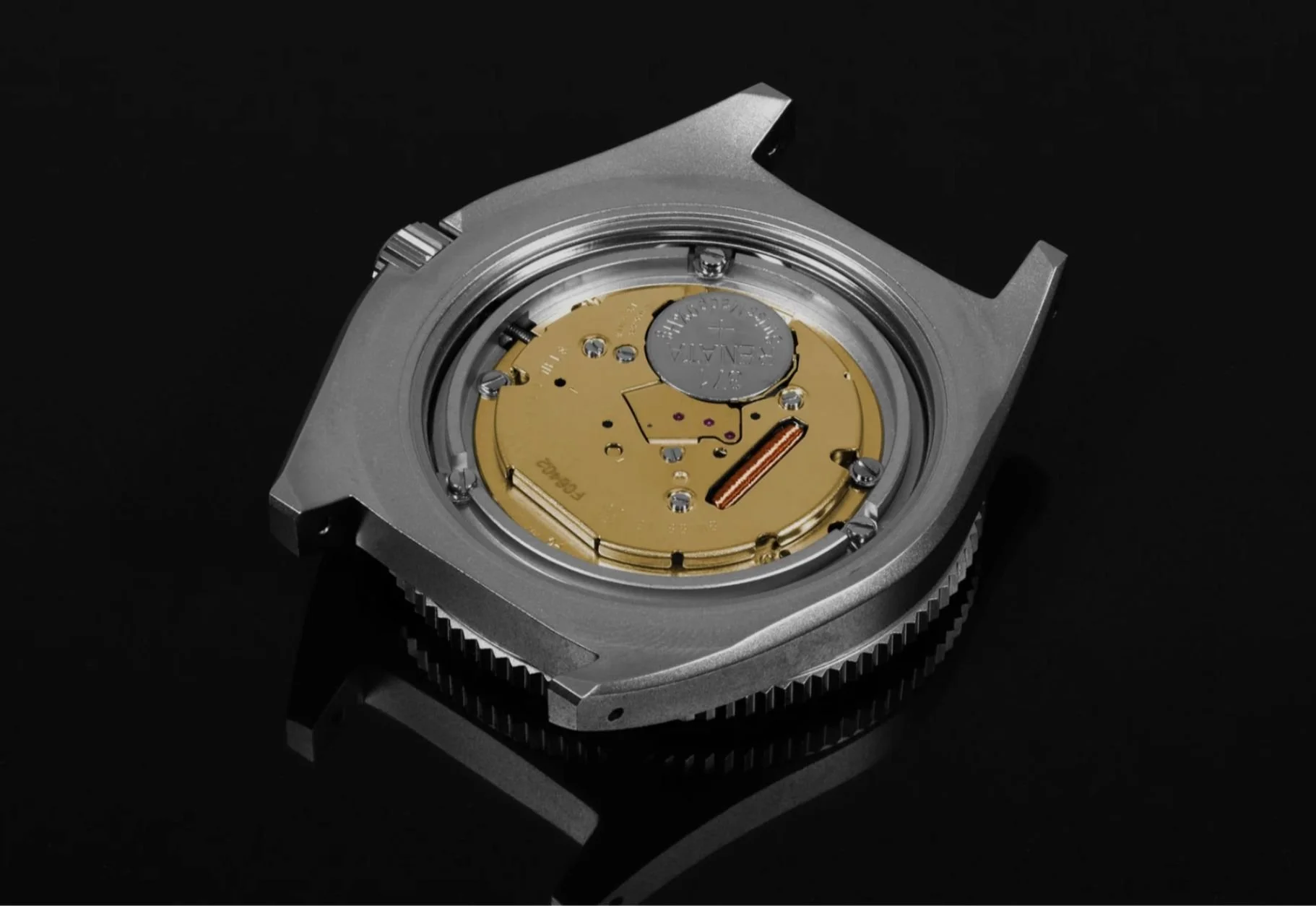
ETA’s F06.402 ensconced in an SSNAV. Marathon says it’s mounted in a steel ring, allegedly for enhanced durability: seems to me a more typical plastic spacer would be a better shock absorbed, but this certainly looks cooler.
This capability would have been astounding for nearly all of horological history, and to me, it’s worth a premium. But in the end I have to admit that this is more a thing to be appreciated in the mind than a feature with enormous practical impact. Getting into HAQ, I couldn’t understand why there was so little demand for it (Marathon and CWC make tool watches with these movements, and there are a handful of models from Swatch-owned brands and a few microbrand offerings: making up a stat, I’ll say 99.99 percent of quartz watches ship with conventional movements). But when I started paying attention to quartz accuracy (as I’ve done for a few of my watches) I noticed that the standard +/- 20 sec per month is actually quite conservative: maybe because I don’t subject myself to a lot of extreme temperatures, the real world performance is much better, good enough that, as with this thermocompensated movement, it doesn’t really matter.
This movement also has ETA’s HeavyDrive feature. I’ll detail what this actually does because it took me some digging to figure out. Brands like to market it as a durability feature that protects the watch in case of impact, but this isn’t quite right. The problem it solves is this: in between ticks, the hands and gear train of a quartz analog watch are just sitting there, held in place by the relatively weak magnetic force of the stepper motor’s stator and rotor. You’ve felt this resistance if you’ve ever turned an electric motor’s shaft with your fingers. Well, if something jolts the watch, the hands can actually exert enough torque on the gear train to overcome this resistance and move. Thus time is either gained or lost, depending on which ways the hands shifted. Not good if you’re trying to hold to 10 seconds per year. ETA’s clever solution (similar, I think, to Casio’s Tough Movement, but I’m not sure who was first) is to use passive accelerometers to detect the shock and near-instantly hit the hands with a counterforce from the motor. This doesn’t protect the watch from damage, but it does protect time from being miscounted. Because this kind of hand movement is a consideration when designing any quartz analog watch and requires the hands (especially the second hand) to be as light as possible to minimize the problem, ETA markets this as “HeavyDrive.” The hands can be heavier without risk of momentum causing the watch to jump ahead or back.
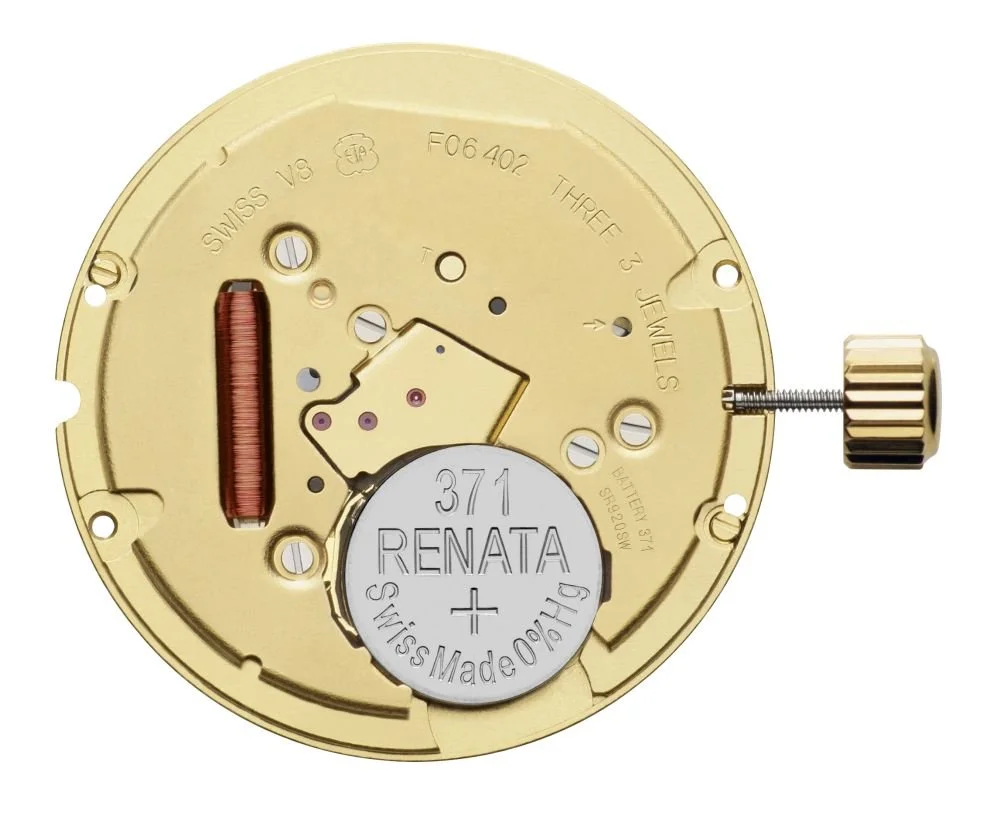
It might be silly, but I like that the F06 movements are gold-plated and jeweled (three rubies in this case). The gold is allegedly for corrosion resistance, but I think it’s mainly to signal quality, and I’m not immune. The jeweling may or may not improve reliability over time, but I like it regardless, even if it’s more a symbolic nod to watch-making precedent than a practical advantage given the minuscule amount of force moving through a stepper-driven gear train.
Despite all this fancy stuff, battery life for the SSNAV is quoted as seven years, which I think is actually a marketing glitch since this movement can get nearly eight years on a thicker 395 battery, but the SSNAV’s case is designed for the thinner 371 cell, which should be good for five years according to ETA documentation. Still impressive. There’s a jumping-seconds low battery indicator so you shouldn’t get caught with a dead watch in the middle of your secret mission.
Other quartz-specific issues: the second snaps neatly without excessive backlash, and my example hits its marks well all the way around the dial (usually spot-on, never more than 10% out), though there’s bound to be sample variation with that.
Mission Failure
I actually started writing this review almost two years ago but am just getting around to finishing it now. I wore the SSNAV nearly every day of that time, until it suddenly lost five minutes just after I’d reset it following a time zone change. After resetting it again (thinking I might have actually mis-set it to begin with), the watch ran for a few more minutes, and then stopped. A new battery did nothing.
At, first I was shocked. Even crappy quartz movements typically long outlast one’s desire to wear a watch, and the SSNAV’s golden ETA is a far cry from the $2 movements that drive many a fashion watch for years without complaint. However, upon more reflection, there may have been some, ahem, user error involved. The day before the watch started acting up, I had taken it upon myself to clean the threads of the screw down crown receiver, as I’d noticed they were getting grotty. I reamed out the muck with the corner of a piece of paper, blowing off the tiny shreds of organic sludge as I went along. Then I screwed the crown back down, congratulating myself on taking such good care of my watch.
Now I think what I actually did was send a bunch of sticky gunk down into the case of the watch where it could start fouling up the gears. Because quartz analog watches are so parsimonious with energy, they don’t put a lot of power into the gear train. Consequently, it doesn’t take much to gum them up. Usually you have to wait many years for hardening lubricants and dust to do the job, especially in a well-sealed watch like the SSNAV. But if you effectively open the case add some gunge yourself, you can speed the process along significantly.

If your Marathon breaks in Europe, this is where it goes to be fixed. I believe this is the same place where the watches are made. Like wounded salmon swimming home, or something. But not dying; being reborn.
Of course, this is all just a theory, so I didn’t feel compelled to mention it to Marathon’s customer service when I called for warranty service. A certain Joe J was very friendly and had me send the watch to their Swiss workshop (if you’re in the US, apparently it goes to New York, and from there to their facility in Canada). I wouldn’t have minded some updates, like knowing when the watch arrived and when it was sent back to me, but the important thing is that it made it and was duly repaired, I think with a new movement. It appeared in my mailbox about six weeks after I sent it out. In the meantime, I had a brief affair with a Timex (this all kicked off when I was away from home without access to my other watches), but that’s over now.
Debriefing
And that’s the SSNAV. A military watch with a story. A tool watch that glows with captive cosmic rays. A pilot’s watch that keeps time in two places at once with incredible accuracy.
In the contemporary parlance, it makes a good GADA watch, as long as “anything” doesn’t include looking classy. This watch has a functional purity that, even if you’re sensitive to the inherent beauty of functionality (and I am), can feel pretty austere. There is essentially nothing decorative about it, which sets it noticeably apart from the astoundingly wide field of watches that aim for a more accommodating balance of function and style.
The SSNAV feels like quality, but it’s quality-as-strength, not quality-as-refinement. The micro-scale perfection that’s widely used to evaluate quality in horology is not what this watch is about. It is carefully engineered to perform, but it has no frills. Sometimes, even after two years, I’ll look at the SSNAV and wonder, “Wait, is this thing actually ugly?” I’m still not sure. I appreciate its functionality too much to see clearly through it.
The SSNAV remains my nightly navigator, but it has begun to share days with my delicate Nomos and my more elaborate Casio. On my wrist, this watch is definitely out of its natural context, but I feel like we’ve come to an understanding. Every day is, in its way, a battle, even if the only flying we do is in coach.