Today we will consider an offering from arguably the most American of watch companies. Like it says right on the dial of this watch, Timex goes back to 1854 in Waterbury (Connecticut) and continues in an unbroken line through today. It was once the undisputed giant of American watchmaking and I think it’s still the volume leader, especially if we don’t look at Fossil, and I’m not. People who say that title now belongs to Apple should be beaten with reeds. Does selling a lot of phones qualify you as the largest maker of pocket watches?
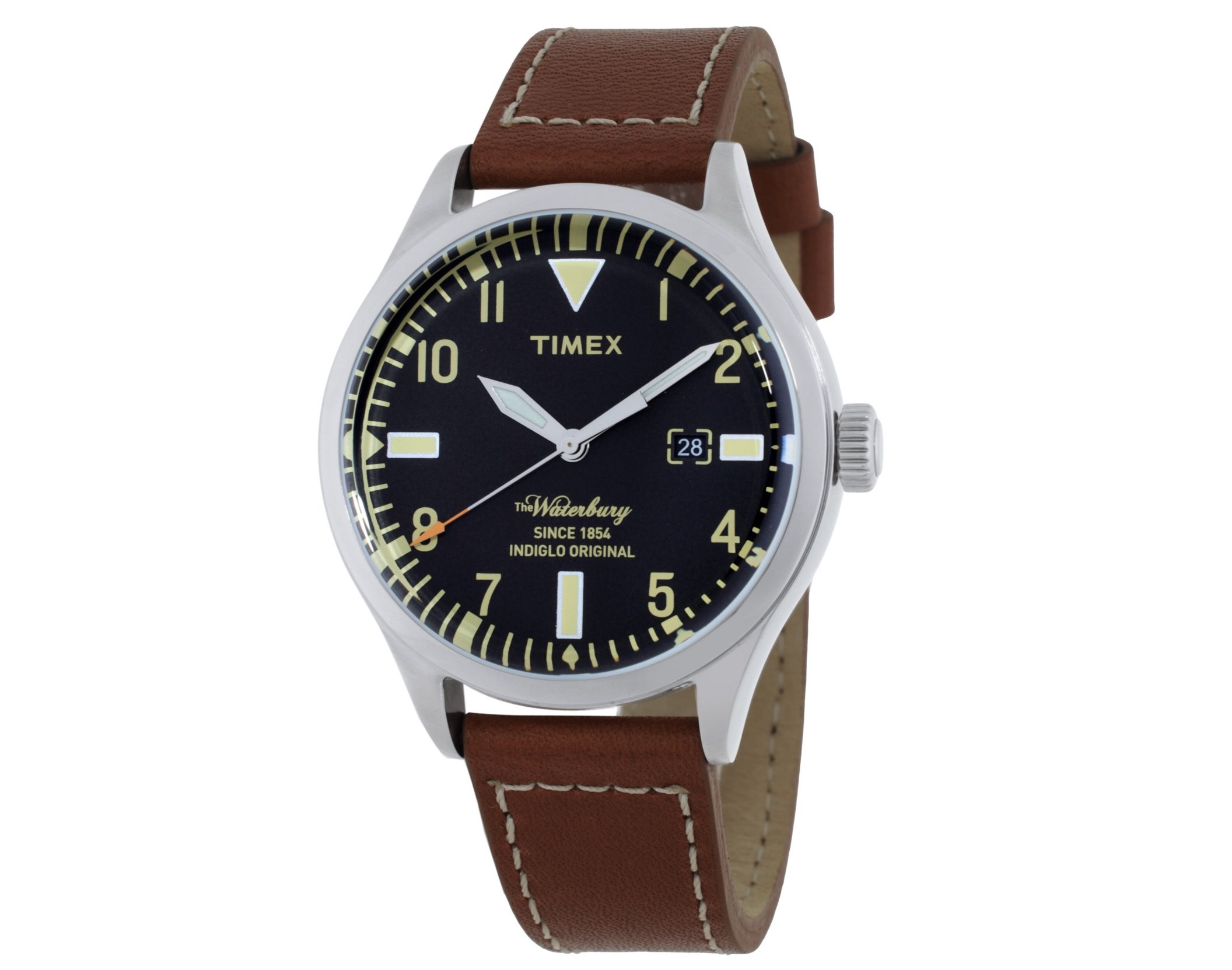
Here’s a shot of the watch in question, ripped without permission from the Jomashop site. I assume it’s actually provided by Timex; I can’t imagine any seller taking the time to photograph something this nicely if it sells for $49.95. In real life, the dial does not look that black.
I have a fancier night-readable watch that I will eventually also review, but guess what? It stopped working. So while I waited for it to come back to me from Switzerland, I needed something that I could read in the dark, but I didn’t want to pay much for a placeholder. I remembered all those Indiglo ads I saw as a kid. Good work playing the long game, Timex.
So I started looking for a deal on an Indiglo Timex that wasn’t too ugly (that rules out the OG Indiglo Ironman watches). The Timex catalog is vast beyond imagining, but I made life easier by perusing the discounted models at jomashop.com. It didn’t take me long to zero in on one: low-key field watch vibes without (I hoped) being too generic or military looking. I paid my $60 (including taxes, shipping, bribes to interstate border controllers, and tips for porch pirate guards) and settled in to wait.
Background: A Long Time Coming
I read up on Timex. I almost bought Timex: A Company and its Community 1854-1998, a corporate history commissioned by Timex itself. It’s been out of print for decades and is weirdly expensive, but in order to give you a properly full background on the company, I almost did it. If I loved you more, I would have. Instead I just browsed the web and learned how Timex was born of a brass company looking for something to do with all that metal. How it made its bones by undercutting more expensive European watches that were better with cheap watches that were good enough. How it made fuses and timers in WWII. How it was thrashed in the quartz crisis but quickly pivoted to leverage the new technology. How the company moved production to the Philippines in 1979, vertically integrating in a way that reminds me of Casio’s Japanese factories.
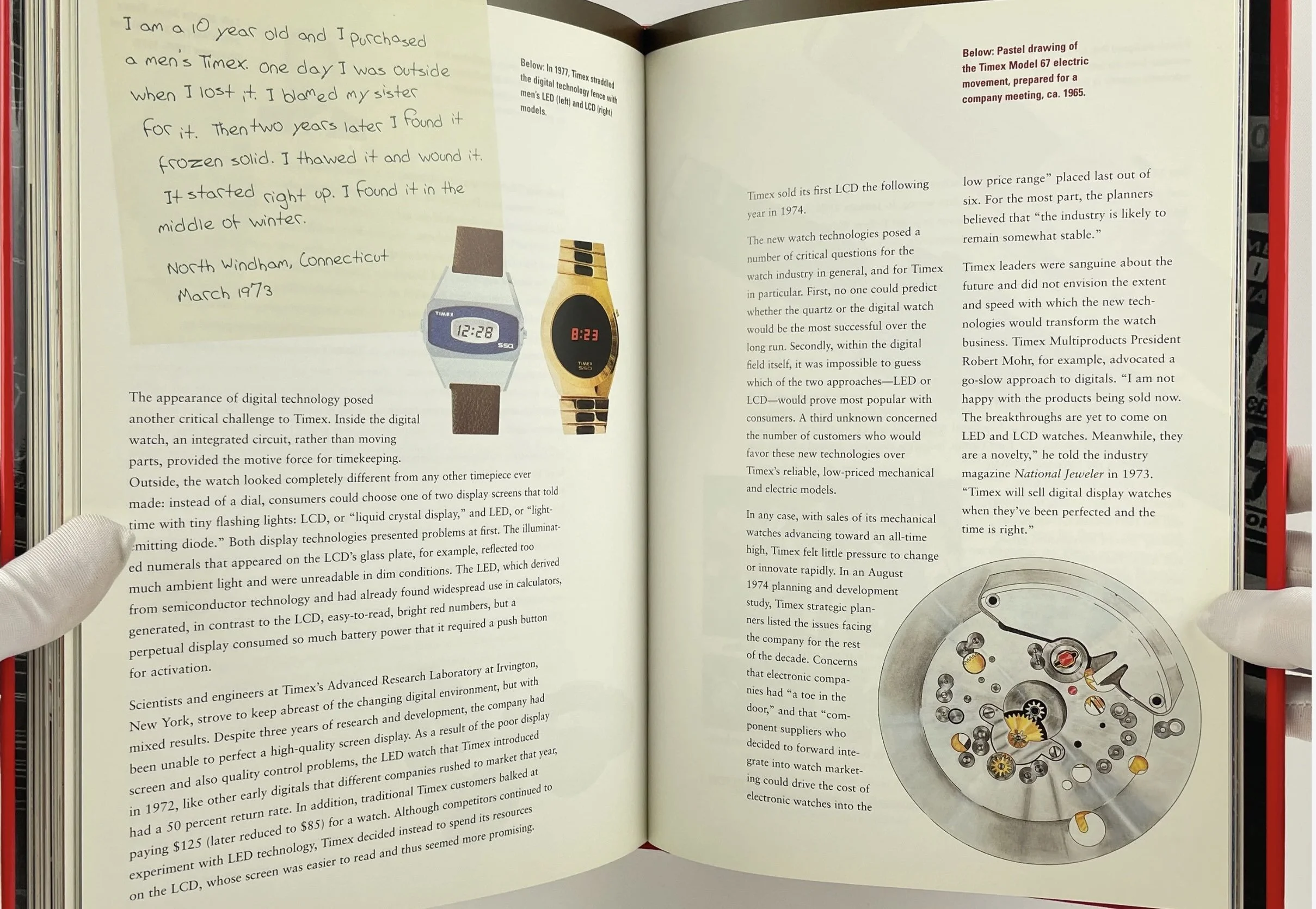
From Timex: A Company and its Community, courtesy of an old auction listing. In 1974, with quartz beginning to make its presence felt: “In any case, with sales of its mechanical watches advancing toward an all-time high, Timex felt little pressure to change or innovate rapidly.”
How American is the Philippines? A lot of the country speaks English, and they fought their own revolutionary war, just like America did, except it was against the US rather than England, and they lost, at least at first. To be fair, they’d already been fighting the Spanish, who’d colonized them for some four hundred years. In fact, the US was initially an ally to the Philippines, since it was also at war with Spain. But then Spain and the US called it quits, and part of the deal was that Spain would “give” the Philippines to the US. The Americans and Spanish could both imagine how the Filipinos would feel about that, so in a comic twist they concocted a fake battle in which the Spanish pretended to lose to the Americans so they could take over on the sly. This didn’t fool the Philippine army for long, and soon enough (and not for the last time) the Americans flipped from liberators to occupiers. The ensuing fighting was brutal, with hints of both the Great War to come and future perils of running a counter-insurgency campaign against a committed opponent. In the pockets of many of those Amercian solidiers was the Ingersoll Yankee, aka the Dollar Watch, a cheap, jewel-less pocket watch made in partnership with the Waterbury Clock Company, nee Timex. This reasonably accurate, durable timepiece was affordable for average (GI) joes. Adjusted for inflation, The Waterbury costs about twice as much as the original Dollar Watch (but your basic fashion watch often comes in at $30 to $40, right in line with the old DW after 120 years of inflation).
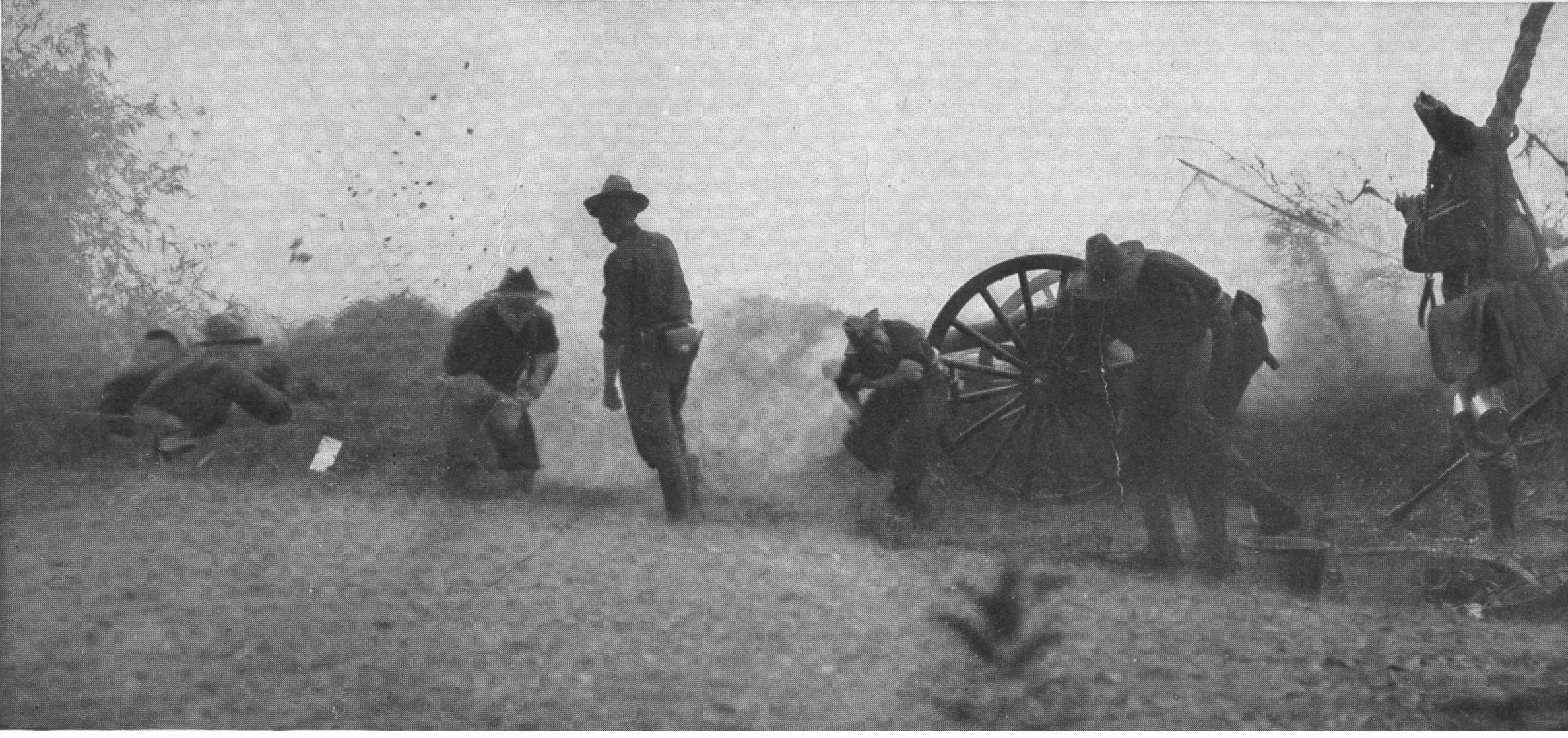
Some Americans shooting their canon at the Saint Juan Bridge. In their pockets, Dollar Watches made by the Waterbury Clock Company are a statistical possibility.
After a fair amount of bloodshed the Americans looked at their pocket watches and decided it was time to declare victory, though corners of the Philippines didn’t get the message until some years later. And eventually a mix of idealism, racism, and pragmatic bean-counting led the Americans to give the Filipinos their country back, and they lived happily ever after, apart from an exceptionally savage occupation by the Japanese during the Second Great War. That let the country’s fighters exercise the guerrilla tactics honed against the Americans and in a twist, ended with the return of those same Americans, but this time as liberators for real. Such a tangled web.
Compromises vs. Comprised
When the box arrived, my hopes were high. Had American ingenuity and high volumes allowed Timex to deliver some kind of astounding value proposition?
First impressions were not great. My watch-snob fingers were startled, maybe offended, by how light The Waterbury feels. Stainless steel seems ubiquitous these days if you live in the world of $100-plus watches, so you might not realize what lurks at the bottom of the price ladder. The Waterbury’s case is made of brass, which is not a clever nod to the origins of the company but a cost-cutting move only occasionally seen in bottom-of-the-line offerings from mainstream brands (Casio has some) and the cheapest watches on Aliexpress. The Waterbury, perhaps also owing to cost-effective eggshell construction, feels hollow: it’s not a small watch, at 40mm across and 11mm thick, but it feels like a metal balloon.
Brass has lead in it and corrodes easily, so it’s not ideal for the wrist microclimate. The solution, in the past and now, is chrome. But the hexavalent chromium you might know and love from the satin durability of a 1950s camera body has fallen victim to wokery and fears of cancer, so now we have weaker stuff. It doesn’t practically matter since this is hardly meant to be an heirloom, but still. I’ll give The Waterbury a few points for bothering with the brushing on the top of the lugs and around the bezel, which is definitely nicer than leaving it shiny all over. The caseback is of course stainless steel as it’s been on all but the shittiest watches since forever, so you don’t have to worry about weird skin reactions. But the caseback also betrays the fact that it’s a generic part used across different Waterbury variants: while most of the text is stamped as you’d expect, the reference number is faintly lasered on and at a slight angle.
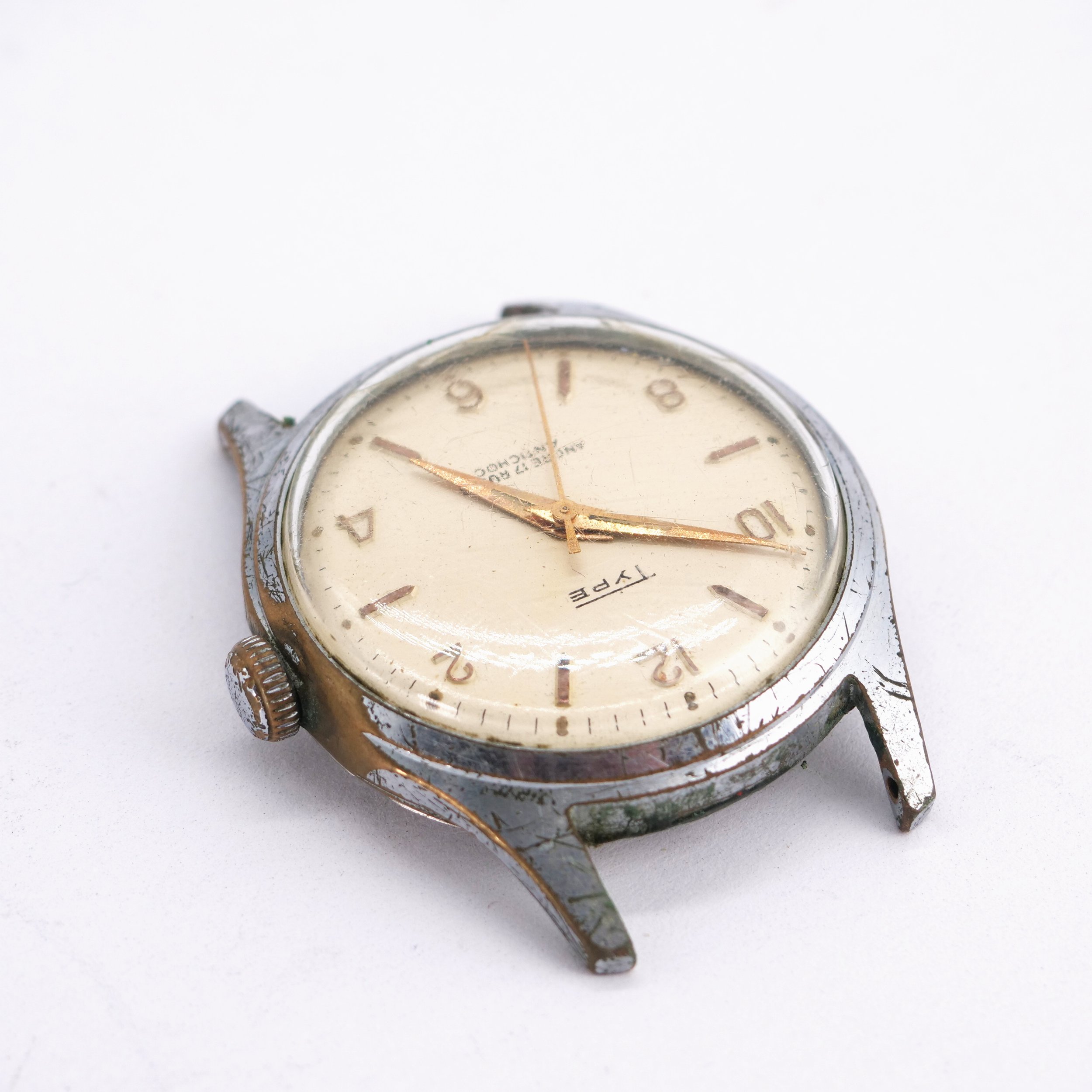
If by some miracle The Waterbury found itself in service after fifty years, it’s chromed brass case might look like this.
Let me now temper this criticism by comparing The Waterbury to another watch in my family, the all-plastic Swatch I bought for my daughter. That Swiss-made object has all the solidity of a cereal box toy. It feels utterly disposable. Its acrylic crystal looked battered after its first day in grade-school. And it cost more than the Timex.
Anyway, let’s put The Waterbury on. I like the color of the leather strap, and it’s comfortable. The buckle is signed. It’s not insulting at all until you notice the numbered adjustment holes. Is this a thing? It implies that the wearer is too stupid to just cinch the watch on comfortably. Do you need to be reminded which hole you used last time? Do you need help tying those shoes? Speaking of shoes, the inside of the band is graced with a “Red Wing Shoe Leather” stamp, surrounded by the words “Handcrafted” and “Red Wing, Minn.” I looked this up, and it’s a real shoe brand that at least partly makes its wares in the US. And Timex does have some verifiably American-made Red Wing straps on some higher end ($500) offerings. So maybe operating at scale has indeed created some value for The Waterbury. Shame about those numbered holes.

I took this with my phone so I could enlarge it (“Computer! Enhance!”) enough to see with my increasingly hyperoptic eyes.
Dial: A Field Watch with a Monocle
With the watch on the wrist, let’s look at the face. It’s dark, allegedly black but to my eye there’s a nagging brown component. Arabic numbers excepting the cardinal points, which get chonky rectangles and an inverted triangle at 12. Below the 12 is “TIMEX” in a timeless font. All of this is a cream color that I’m hoping is not supposed to look like old radium, because that irritates me (better than irradiatiing me, I suppose).
If only they had stopped there. Unfortunately, this a watch designed to entice buyers from inside a mall display case, so the face also declares that this is an “Indiglo Original” (surely that would be a Timex Ironman, a stick-in-the-eye of practical engineering that looks nothing like a Waterbury). Then we have a tiny “The” followed by “Waterbury” in a fey script, and “Since 1854,” because the Waterbury brand is all about nostalgia but the company can’t trust you to know its history. My vote would have been for a more sterile dial, but I’m not really the target audience.
Over this dial we find a sword hour and a pencil minute hand, looking stamped out of something and polished with lumed central accents. The lume is key, not for glowing (which it only does for about five minutes), but to keep the flat hands from blacking out and vanishing against the dial. They’re joined by a more elaborate second hand: a needle extending to an arrow tipped in red on one side, with a narrow isosceles counterweight. The arrowhead nearly touches the minute hashes and gives the design a nice splash of color. There’s also a tiny date window next to the 3 o’clock marker.
Flicking open my Belomo loupe, I felt like someone about to shine a blacklight on a Motel 6 bedspread, but I was pleasantly surprised. Finishing is simple but neat and competent. The only real QC issue I caught (apart from the slanted printing on the caseback) was a dark fleck on the hour hand, clearly visible to the unaided eye once you know it’s there. The hands are flat-stamped, no beveling. The dial printing is crisp, the applied cardinal indices perfectly aligned.
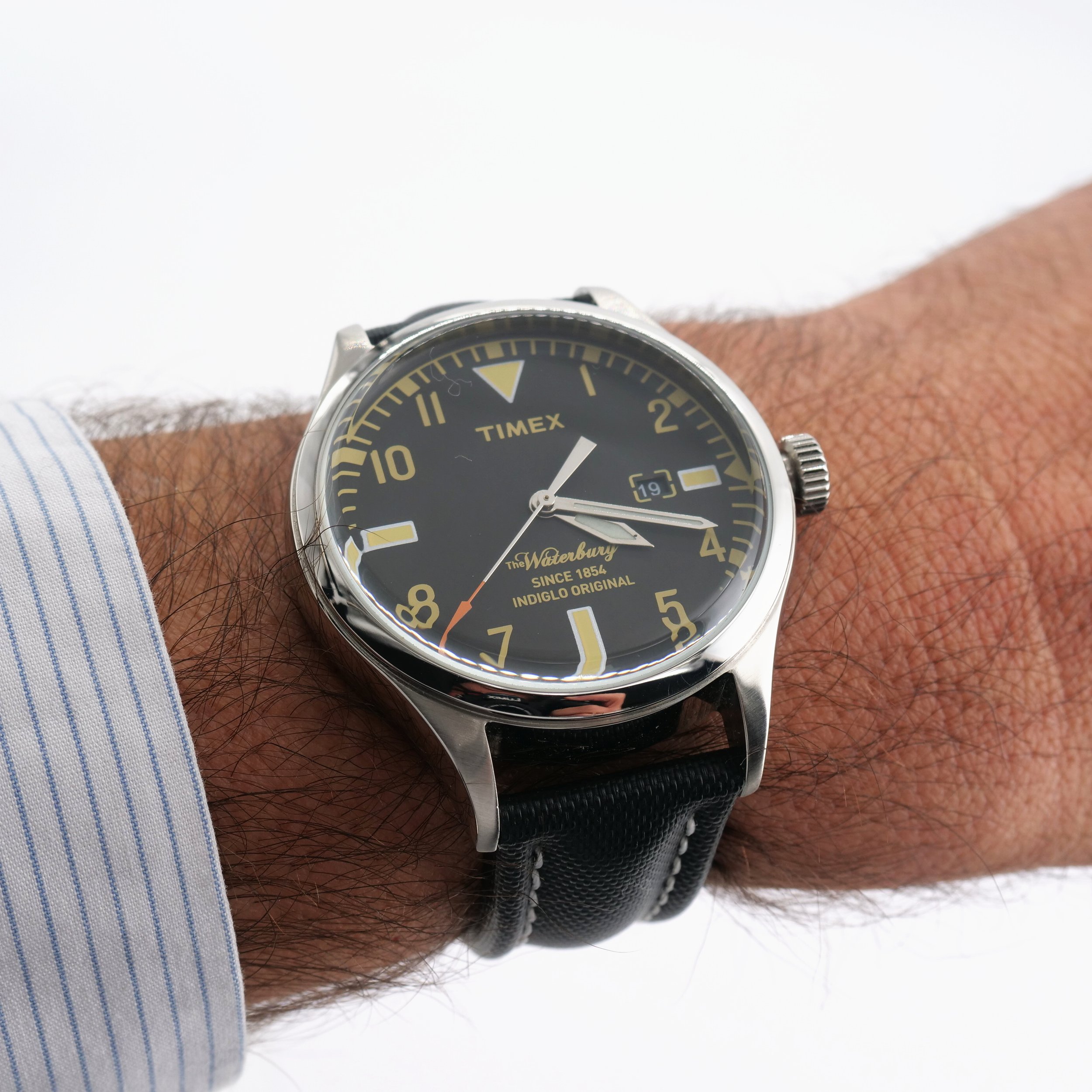
The watch, on an Artem sailcloth strap my brother gave me, showing generally good legibility. The mineral crystal protrudes well above the bezel and introduces the kind of edge distortion that some people apparently like, but the crystal is actually flat past its beveled edges so there’s no dome here (no sapphire at this price, either). More like a mesa. The polished bezel has transformed my shooting hand into AI-inflected dactyl horror.
All of this adds up to a nicely legible watch without being quite as boring as, say, a Timex Weekender. It wears big, despite being nominally a 40mm case, because the dial runs right to the edge with a minimal bezel.
Oh, knob feel. The crown action on this watch is frankly miserable. At first I didn’t even realize it had a quick-set date, as there’s no real “first click:” you just pull it out a little to set the date, and a little more to set the time, with no tactility to speak of.
On the plus side, unlike my daughter’s Swatch, this watch does hack. And unlike some far fancier Swiss movements I’ve known, pushing in the crown to start things running again doesn’t displace the minute hand. And the second hand alignment on my example is good: not perfect, but I wouldn’t complain about it even on a watch the cost ten times as much.
Movement: We are Anonymous. And We Glow.
The whole show is powered by, wait for it, an in-house movement. It amuses me that while, on the mechanical side of things, everyone who tweaks a screw head on some bog-standard caliber crows about their new “in-house X7 Megatime movement,” Timex has a built-from-scratch quartz movement that it not only sells for peanuts but doesn’t even bother to name. I’ve seen tear-downs, so I know it has a metal cover over mostly plastic internals. Unlike the cheapest ETA quartz movements, you can disassemble it without breaking it: Timex still uses screws, not that it would ever be economical to fix one. It’s powered by a lithium CR2016 cell to feed the hungry Indiglo dial, about which more later. I haven’t found a lifetime quoted anywhere, but if you keep your fingers off the Indiglo button my guess is this thing will run for a while: the lithium cell packs two to three times the energy you’d get from a more-typical-for-watches button cell.
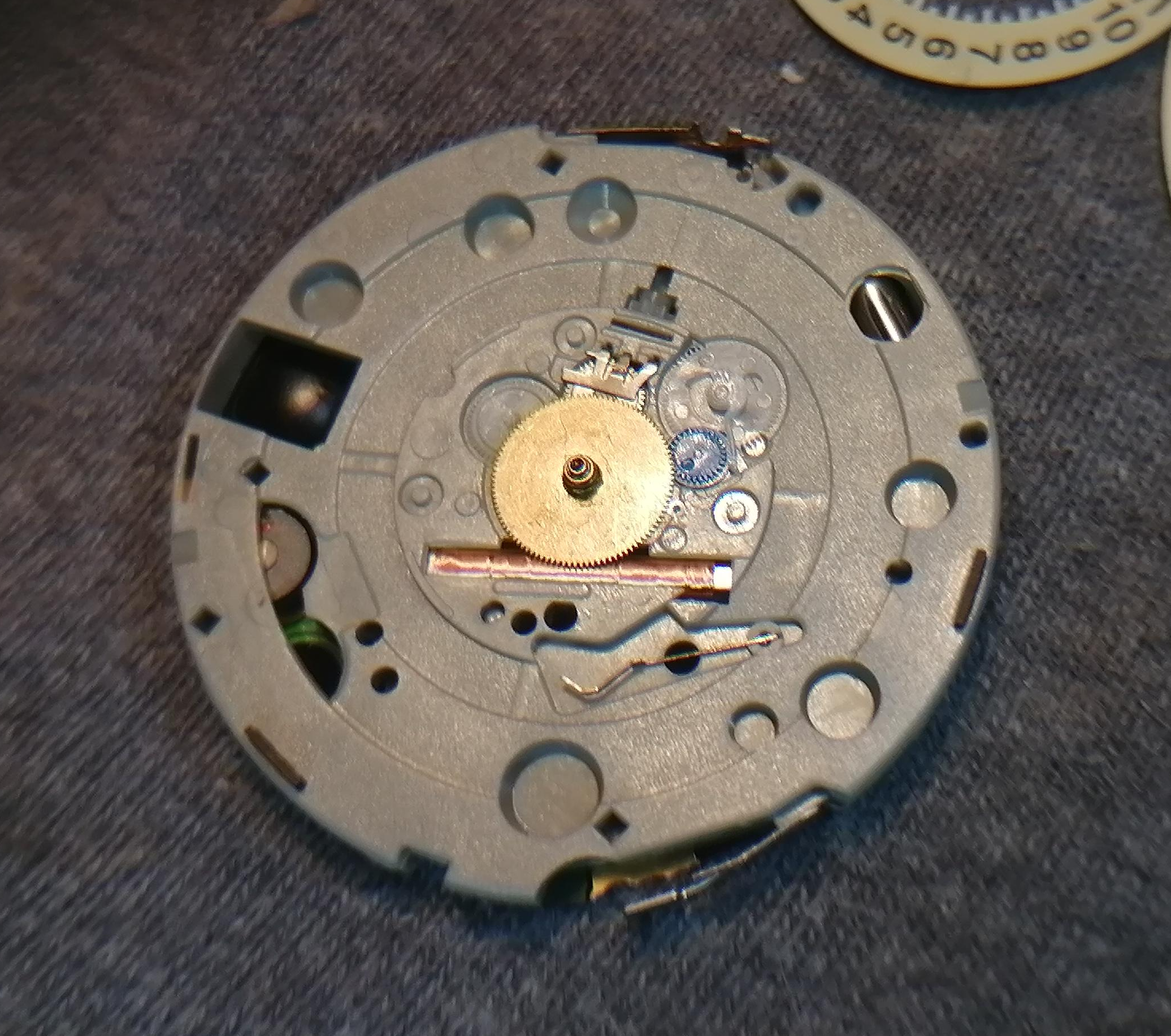
This could well be the movement found in the watch in question: this image comes from a Reddit thread in which a guy is trying to repair his Timex Expedition, a similarly-sized three-hand-plus-date Indiglo model. From the dial side, we see the plastic baseplate and a brass and plastic wheel train. The other side looks more metallic, but is mostly a cutout for the big CR2016 battery. These movements presumably have internal designations at Timex, but there’s no clue on the thing itself.
And yes, it’s loud. Timex quartz watches are famous for loud ticking. It’s worse than the aforementioned Swatch, and I was shocked by the racket that little thing makes. The Waterbury is loud on the wrist, and with the case sitting on a hard surface, perched on the needle-point contact patches of its lugs, it’s even louder: the case seems to act like a bell, amplifying the sound of the stepper motor. Does it matter? Not to me. At night I wear earplugs, and during normal knocking around I never notice the ticking. But if you are, say, a student who often finds yourself in quiet rooms with other people trying to concentrate, this is probably a deal breaker. Some misophonic nutter will eventually lunge at you with sharpened No. 2.
Now, the headline feature that led me to this watch: Indiglo. I don’t pretend to really understand this technology, but apparently you can get a whole surface to glow a pale blue-green if you sandwich something like gallium arsenide between two conductive plates and then hit it with a high-voltage current. Earlier cool applications included the dashboard of the 1966 Dodge Charger and the airspeed and altitude indicators in the Concorde. Timex cleverly figured out how to scale this down to watch size with a tiny transformer to pump the trickle you get from a button cell up to the couple of hundred volts needed to make things electroluminesce and released its first Indiglo watches in the early 90s.
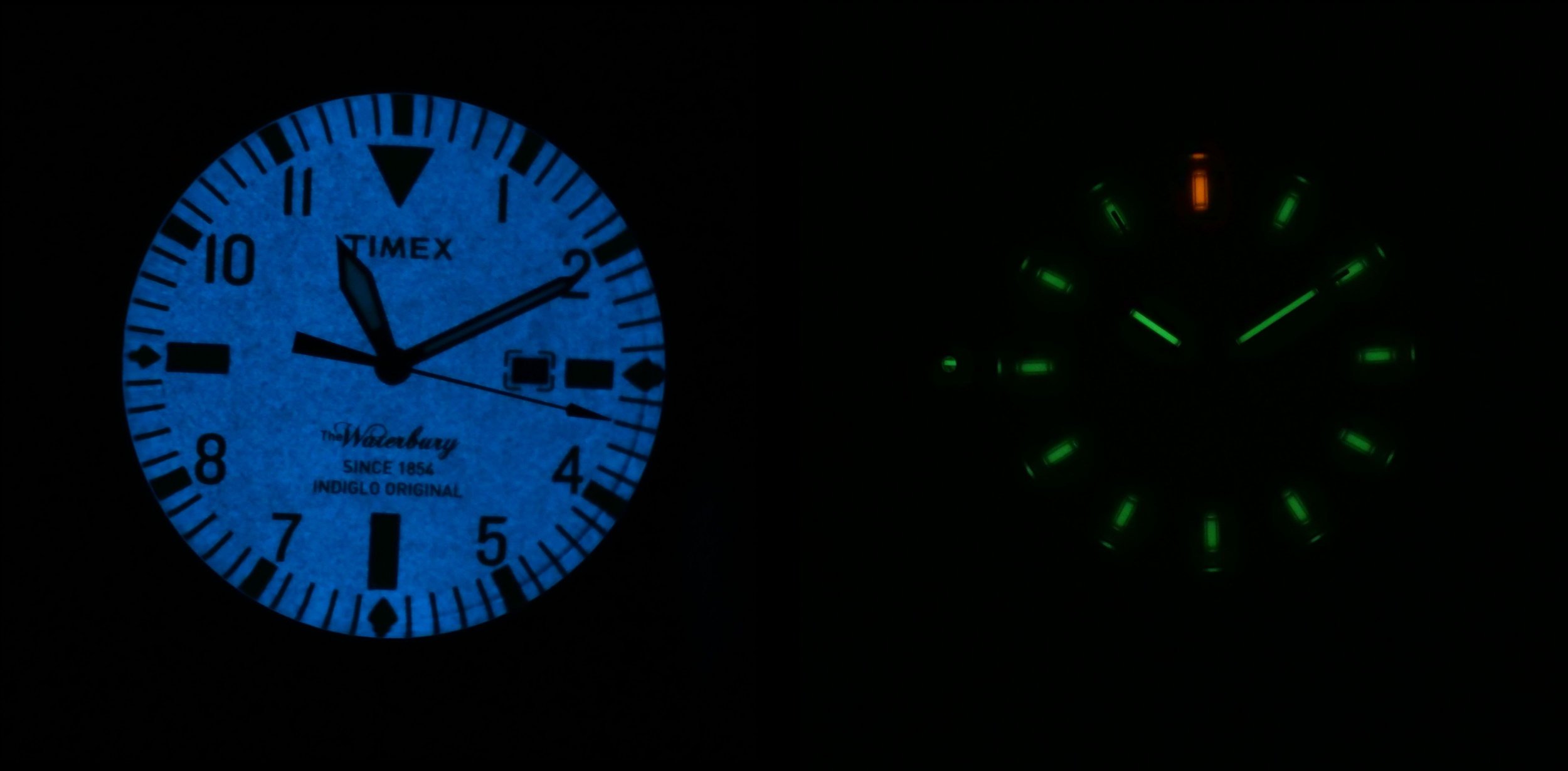
The Waterbury Indigloing at night, next to a watch with tritium lume. For some reason the Indiglo looks better in photos than in real life.
Indiglo does indeed glow, but it also imposes requirements on the dial design that are not immediately obvious. I had read that white dials are “better” with Indiglo than dark ones, and I assumed that meant that the lighter dials just glow brighter. Maybe they do, but that’s not the problem with this watch: the dial makes plenty of light. The problem is how lighting it changes the readability. In normal light, we have light markers against a dark dial, classically legible. In darkness with Indiglo activated, we have a light dial, with the markers now shading its emission. They are indeed opaque, but the problem seems to be that light coming off the dial then reflects off the inside of the crystal and onto the light-colored markers, which lightens them and makes them stand out less against the dial. The result is oddly low-contrast, and with night blurry eyes, the dial becomes a lot less readable than I’d expect.

I tried to simulate what I actually see with 3am-blurry eyes. This doesn’t actually capture the lower contrast on the Indiglo dial, and it makes the tritium seem dimmer than it would in reality, but you do get a sense of how the legibility of The Waterbury degrades more than simple tritium indices as you add blur.
The view is further compromised by the handset. The needle-thin second hand almost disappears, but its fatter counter-weight does not, and in fact ends up a looking a lot like the hour hand. If you really study the dial, of course you’ll be able to figure out what’s going on: the second hand moves, for example. But at a glance at three in the morning, this is all pretty confusing.
The Verdict: I Did it to Myself
And that’s The Waterbury. Cheap (in both price and tactility), highly legible in daylight, not fugly but not exactly handsome, of legitimate horological provenance, but really not great for me as a night-readable watch. I let my natural affinity for field watches cloud my judgment when I bought this: I thought I wanted legibility without the cookie-cutter looks of an Expedition, but for me, The Waterbury isn’t quite interesting enough to justify some of its design quirks. There’s something impure about the dial color, and its darkness really shoots Indiglo visibility in the foot. Surprisingly, the extra branding got on my nerves more than the loud ticking, but that will certainly piss off somebody too.
Learning about this watch has given me a new appreciation for Timex as a historical player, and perversely probably left me more interested in exploring the brand’s offerings. I think a slumming watch snob could do better than The Waterbury (sniff around Casio, Lorus, even other Timex lines). But they could also do much worse.